











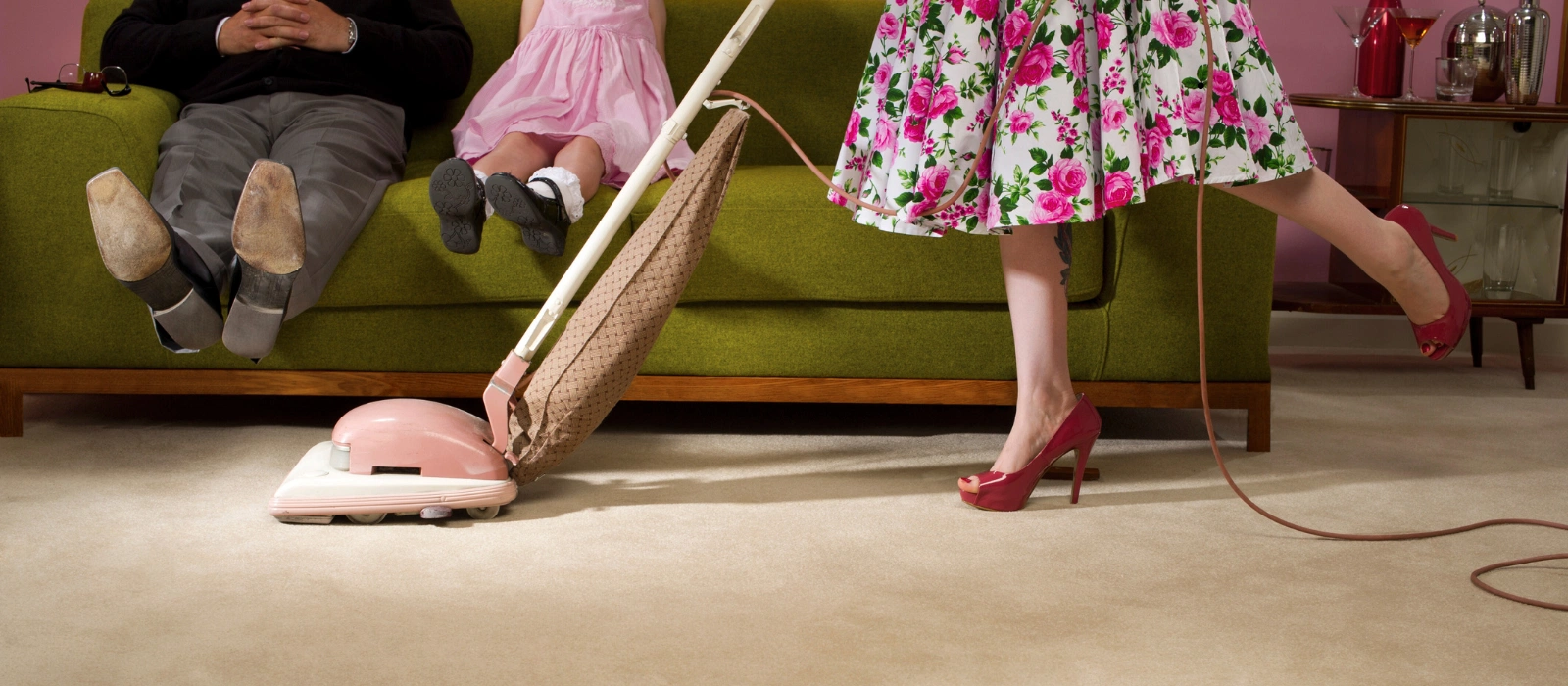
Domestic labour is still a battleground in marriages but some women are walking away from the fight
In 2025, marriage remains a better deal for men than women: men gain leisure even when unemployed, women lose it even when successful, and a rising number of women are refusing to pay the social and economic price of domestic imbalance, writes Roe McDermott.
In 2025, marriage remains a better deal for men than women: men gain leisure even when unemployed, women lose it even when successful, and a rising number of women are refusing to pay the social and economic price of domestic imbalance.
When men lose their jobs, they gain something surprising: more free time. A recent paper from the National Bureau of Economic Research shows that men who are unemployed expand their leisure hours dramatically, while their wives, who are suddenly responsible for both the paycheck and the housework, take on even more of the load. The men are not spending this time looking for jobs or using their free time to contribute to the domestic labour necessary to run and maintain a household. They are simply enjoying themselves. This detail, tucked into a meticulous economic study, reveals something blunt about heterosexual marriage: it gives men more time and takes time away from women.
The paper, Winning the Bread and Baking It Too, measures how couples divide unpaid work and finds that marriage systematically shifts the balance in men’s favour. Once married, women spend more time cleaning, cooking, and caring, while men spend less. Divorce flips the pattern: women’s housework falls, men’s rises. The pattern is so consistent that it holds even when she earns far more than he does. The same man who will cook and clean when single or divorced somehow forgets how when a wife is in the picture. This is not a matter of skill. It is about believing that someone else’s time is available to you.
The study also explodes one of the most persistent myths about heterosexual households: that this division of labour is efficient because women are naturally better at it, either through socialisation or ability. If efficiency were the explanation, then marriage should reduce the overall cost of running a home. Instead, the researchers find the opposite: households become more efficient upon divorce. The reason is that married women are not only doing their share of the work, but also cleaning up after husbands, managing their needs, and compensating for the additional work they generate. Husbands are effectively an extra dependent, creating more tasks without contributing to them. Women’s unpaid labour is not a streamlined specialisation but an extra layer of overtime. What’s more, when women are unemployed, they do not experience the surge of leisure that unemployed men enjoy; their housework simply increases. And women who outearn their husbands often end up taking on more domestic work to avoid threatening his sense of masculinity – or outsourcing chores to paid cleaners or childcare workers, so that he doesn’t have to. The supposed efficiency is a myth masking entitlement, with women carrying the hidden costs.
These burdens carry over into the workplace. The researchers show that women scale back their paid work to meet unpaid demands at home, while men’s housework remains fixed, no matter what. Households lose out on income not because women lack ambition, but because their careers are throttled by the hours they spend scrubbing kitchens and folding laundry. You could think of it as running a two-person business where one partner keeps the books, manages the clients, and still takes out the trash, while the other pockets the profits as leisure time. Small wonder that women who anticipate being the main earners are increasingly opting out of marriage altogether. If a promotion comes with more dishes, who needs it?
Once married, women spend more time cleaning, cooking, and caring, while men spend less.
The data on leisure is especially revealing. Women’s free time is carved into fragments, often interrupted or overshadowed by the mental load of managing a household. Men’s leisure, by contrast, comes in longer, uninterrupted blocks – a full round of golf, an afternoon on the couch, an evening out. Sociological studies add another layer: women’s leisure is more often encouraged to take place at home, where it can be interrupted by children or chores, or in activities that serve the family or the home itself, like gardening, baking, or organising. Men’s leisure is more often protected, external, and individual. After divorce, women who share custody often describe a sense of relief, because for the first time, they have stretches of time that belong only to them. Divorced men, on the other hand, often say they are less happy because shared custody means they suddenly have to manage everything without a wife to absorb the daily grind. The asymmetry is glaring: women feel relief when freed from managing their partners as well as their children, while men feel strain when they can no longer outsource their domestic needs.
What keeps this inequality alive is not accident but strategy. Husbands who claim they cannot fold laundry correctly, or who “forget” to buy groceries, or who shrug that they never notice dust, are not displaying incompetence. They are making their wives responsible for both the task and the blame if it is left undone. This is what has come to be called weaponised incompetence, and it is reinforced by entitlement. Economists describe it as men “purchasing” home production within marriage. In plain language, it is taking a partner’s labour for granted and enjoying it as a right.
Meanwhile, a cultural backlash is trying to repackage this inequality as empowerment. The rise of “TradWife” influencers on TikTok and Instagram offers women an escape from professional pressures by embracing full-time domesticity. Their aesthetic is calm, their message seductive: let go of career stress, lean into homemaking, and reclaim a simpler, less demanding life. But the promise is hollow. What looks like relief is really restriction. These women are not freed from responsibility; they are boxed into it. They trade financial security and personal independence for a role that benefits men twice over – privately, by handing them more leisure, and politically, by keeping women out of positions of power and influence. The TradWife fantasy is not about women’s well-being but about re-entrenching the same structures that research shows are already draining women’s time and energy. It sells disempowerment as self-care.
And yet, while the internet is awash with nostalgic visions of domestic bliss, public debate wrings its hands over why women are marrying later, marrying less, or not marrying at all. Politicians warn of demographic decline, commentators lament falling birth rates, and conservatives wax romantic about the 1950s. But women are not abandoning marriage because they disdain companionship. They are rejecting an arrangement that adds to their exhaustion, clips their ambitions, and consumes their hours while granting men more time off the clock. For men who worship a capitalistic patriarchy and Republicans who worship a salesman who somehow got elected President, they seem to be playing dumb by refusing to recognise that for women, marriage is often just a bad deal.
There is also a generational cost to this inequality. Children watch these dynamics unfold. Boys grow up seeing their fathers opt out of household work while their mothers juggle everything. Girls grow up watching their mothers clean up after grown men as if they were additional children. The cycle reproduces itself in the next set of households unless it is deliberately broken.
The solutions are obvious but persistently ignored. Boys should be taught not just to cook but to take responsibility. Workplaces should normalise men leaving early for childcare and refuse to reward them for passing it off to women. Marriage itself must be redefined not as a license for men to expand their leisure but as a partnership in which time and labour are divided fairly. The NBER researchers are dry in their phrasing, but their conclusion is unmistakable: the next frontier of gender equality will not be won in the boardroom but in the kitchen, the laundry room, and the everyday rhythms of home life.
The injustice is glaring, and the symbolism is larger than chores. Every hour a woman spends cleaning up after a man who claims to be her equal is an hour she cannot spend on her career, her rest, or her joy. It is an hour lost to progress itself. And the most dispiriting part is that in 2025, we are still here, arguing about dust and dishes. But what looks like a fight about housework is really a fight about freedom. Women have begun voting with their feet, walking away from marriages that ask too much and give too little. And while TradWife culture tells women to retreat into submission, the evidence tells a different story: until men stop treating housework as beneath them, marriage will remain what it has long been – a better bargain for men than for women.
Also Read