

‘Catherine Connolly is a glimmer of hope in a tired republic’
After a dispiriting election and deepening crises, Catherine Connolly’s presidency signals a confident, inclusive Ireland, resisting the narrow nationalisms of our age, writes Roe McDermott.
There are moments in a nation’s life when the ceremonial feels unexpectedly intimate, when the choreography of statehood reveals not pomp but possibility, and Catherine Connolly’s inauguration at Dublin Castle was one such moment. It arrived, notably, after a long stretch in Irish public life when there has been precious little to feel hopeful about. The housing crisis continues to hollow out communities and futures, the cost of living crisis has left many exhausted in ways that statistics rarely capture, and the presidential campaign that preceded the inauguration was a deeply dispiriting affair marked by underqualified candidates, internal rancour, moments of nastiness and an unmistakably low voter turnout that spoke to a wider national weariness and disillusionment. The need for hope and vision in Ireland has rarely felt so acute, despite the longstanding integrity and moral imagination Michael D. Higgins brought to the office. (Not to mention the joy brought by his dogs. I have often sent friends in America photos of Miggedly and his beloved pups, bragging about our intellectual poet-hobbit President and his ever-present canine companions. In this political climate, you need to grab some moments of joy and superiority when you can.)
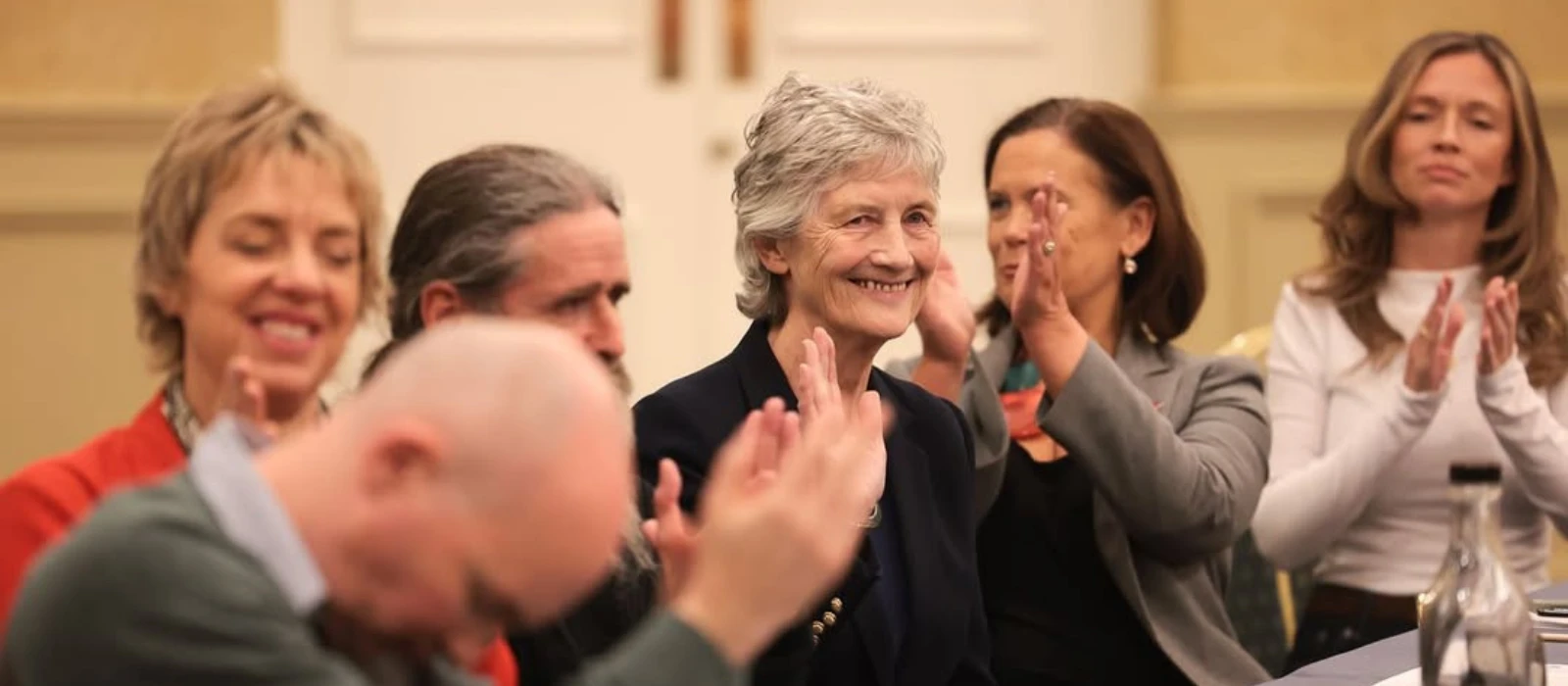
Yet even within our current atmosphere of disenchantment, Connolly’s election offered a glimmer of possibility. Her campaign had not been frantic or flashy, but instead rooted in ideals and in the need for a republic that moves beyond complacency. As she spoke of a vision for Ireland grounded in dignity, inclusion and progress, there was a sense that something steady and quietly transformative might hopefully be beginning.
It was not only the ascent of the tenth President of Ireland but the quiet unfurling of something older and more stubbornly hopeful in our political imagination, something shaped by women who have stepped into Áras an Uachtaráin and bent the symbolic arc of the office toward a fuller vision of who we are and who we might yet be. Connolly now joins that lineage, standing where Mary Robinson once opened a window to the world by transforming a previously ceremonial office into a platform for human rights, diaspora engagement and a more outward-looking Ireland, and where Mary McAleese devoted her presidency to the painstaking labour of reconciliation, offering an open hand to communities still raw from conflict and grounding the Áras in the everyday work of peace. Although Connolly arrives at a time shaped by vastly different crises, she carries forward a feminist tradition that has repeatedly expanded the moral and cultural frontiers of Irish identity.
Her first speech, delivered with an ease and conviction that felt almost startling in an era defined by bluster, reminded us that the presidency at its best is a counterweight to the political theatrics that dominate global headlines. She began “humbly and proudly as the 10th President of this beautiful country” and moved immediately into a clear articulation of the values she sees as central to the Irish republic. The people, she said, had given her “a powerful mandate to articulate their vision for a new republic, a republic worthy of its name, where everyone is valued and diversity is cherished, where sustainable solutions are urgently implemented, and where a home is a fundamental human right.” At a time when the world’s attention remains unavoidably pulled toward the spectacle of male superegos on the world stage, toward the performative grievance of Donald Trump and the merciless imperial vision of Vladimir Putin, there is something quietly radical about Connolly’s emphasis on dignity, inclusion and the stewardship of a republic that does not measure itself by militarism or dominance but by the wellbeing of its people and the integrity of its values. The contrast was not merely stylistic; it was philosophical and, in its own way, profoundly feminist. It’s notable that Connolly has often faced criticism for being a dull speaker, when what may be more accurate to say is that she refuses to engage in flash or soundbites, insisting on detail, nuance, attention, and clarity in a world increasingly defined by easy, often untrue populisms and the flattening of political discourse into slogans designed to inflame rather than inform.
Vitally for right now, what Connolly represents is an Ireland that refuses to retreat into the brittle certainties of ethnic nationalism at a moment when, both here and abroad, identity is being weaponised by those who speak loudly of Irishness – defined to them only as whiteness – while showing so little curiosity about Irish culture, history, language, or its roots. It matters that Connolly spoke in Irish and did so without apology and without self-consciousness. “Tír gan teanga, tír gan anam” (a country without a language is a country without a soul), she reminded the country, insisting that when a language is silenced “ní féidir leis an tír, nó aon tír, a mianta, a luachanna nó a spioraid a chur in iúl” (a country, or any country, cannot express its desires, its values or its spirit). Her Irish was the antidote to contemporary distortions, a reminder that the language carries “spioraid ár sinsir agus nádúr ár dtíre le mothú i gchuile fhocal” (the spirit of our ancestors and the nature of our land can be felt in every word), and that authenticity in national identity emerges not from exclusion but from the confidence to welcome complexity. Against those who seek to hijack Irishness as a proxy for whiteness and to use the Irish flag as a symbol of division, not unity, she offered something infinitely more grounded, an insistence that the language will not be spoken “sa gcúinne á labhairt go híseal” (spoken quietly in the corner) but placed “sa chéad áit mar theanga oibre” (in the first place as a working language) and allowed “bláthú” (to flourish) without fear. That she returns the Irish language to the Áras, not as ornament but as a working language, is significant on more than symbolic grounds. She situates Gaeilge as a living inheritance that has always had the potential to bind rather than divide, to deepen connection rather than gatekeep it. Her reassurance that the language will be spoken “go misniúil, go fileata, go ceolmhar” (bravely, poetically, musically) is an invitation rather than a reprimand, a vision of cultural confidence and a recognition of the importance of Irish history and identity.
Her presidency will inevitably draw comparisons to Michael D. Higgins, whose tenure was marked by a willingness to be more forthright than many in government ever found comfortable. Higgins understood the presidency as a moral office and, in doing so, reclaimed it from the risk of ceremonial inertia. He spoke about poverty, inequality, the catastrophe of neoliberalism and repeatedly returned to the rights and dignity of migrants and asylum seekers. Most notably and most bravely, he stood firmly for Palestinian human rights at times when many in politics stayed silent or echoed damaging rhetoric justifying genocide. While critics accused him of overreach, many ordinary people recognised in his words a commitment to a morality that transcends political fashion, economic investments or ethical cowardice, as well as something deeply rooted in Irish historical experience and our solidarity with those who are oppressed.
Connolly seems poised to continue that uncompromising moral clarity, albeit in her own distinct register. Her speech’s most resonant passages concerned climate catastrophe, displacement and war, and in linking these issues, she articulated something that much contemporary political discourse avoids. “I am acutely conscious of the 165 million people currently forcibly displaced from their homes and countries due to war, famine and climate change,” she said, refusing the comfortable abstraction that often accompanies discussions of global crisis. “We cannot turn back the clock nor close our eyes to these realities.” Connolly’s insistence that Ireland cannot retreat from its humanitarian obligations was grounded in a historical memory of “colonisation and resistance, of a catastrophic man-made famine and forced immigration,” a memory that continues to shape Irish political consciousness even when some prefer to forget it. She placed Ireland’s tradition of neutrality not on a defensive footing but on an active and imaginative one, suggesting that our history gives us “a mandate for Ireland to lead” in articulating alternative diplomatic solutions in a world “where, unfortunately, we have all become witnesses to ongoing wars and genocide.”
There was, too, a deep and unmistakable tenderness toward ordinary people that felt recognisably Connolly. She spoke of the “quiet dignity and stoicism of those who simply keep going despite the very real challenges that they face,” paying tribute to those who “chuaigh agus a théann i ngleic le heaspaí seirbhísí agus riachtanais gach lá beo” (who have faced and continue to face gaps in services and essential needs every single day) in a wealthy country that still leaves many behind. She said it was the people who “thug agus a thugann misneach dom” (who gave me and continue to give me courage) and promised to carry that courage into her presidency. It was a gesture of gratitude but also of accountability, an acknowledgement that the republic remains incomplete for many who still struggle for housing, for healthcare, for childcare, for security, for recognition.
Catherine Connolly’s inauguration will be remembered less for the choreography of the ceremony than for the particular clarity of her presence, a clarity rooted in compassion and a fierce sense of justice. “I believe that the President should be a unifying president, a steady hand, yes, but also a catalyst for change,” she said in closing, and perhaps that combination is precisely what the country needs as it navigates a world shaped by climate turmoil, geopolitical volatility and the persistent tug of reactionary politics. That she arrives as the third woman to assume the presidency is not incidental. It is a reminder that women in this office have repeatedly expanded their horizons, insisting that the symbolic centre of the state can be a place where empathy is not equated with weakness and where moral courage is articulated without theatricality.
Ireland has long known that the presidency can be more than a constitutional ornament. With Connolly’s election, the office feels once again like a moral compass, one that orients us toward a republic that is generous, self-reflective and brave enough to speak from the margins when necessary. In a world governed too often by the loudest voices, her quiet authority may prove to be the most transformative force of all.
Photography by @catherine.connollytd.
Also Read