


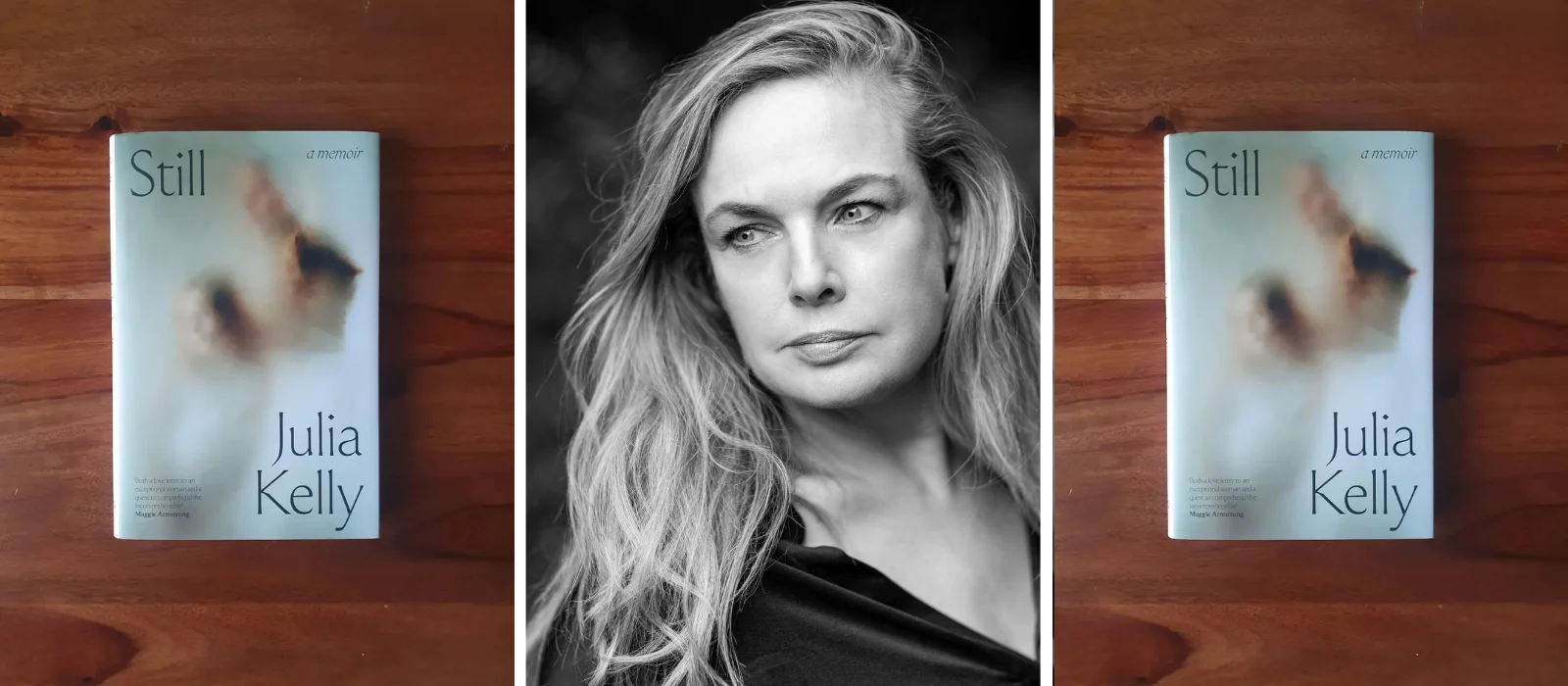
Julia Kelly’s profoundly affecting memoir of grief brings its subject to life in an unforgettable and unexpectedly joyous way. Here, she discusses her inspiration, process and favourite books.
Julia Kelly’s mother, Delphine, spent much of her life in the shadows as a politician’s wife, tending selflessly to the needs of her husband, John, and five wild children. Rattling around in a draughty house, the siblings – though much-loved – are left largely to their own devices, tended to by a series of hapless au-pairs, dodging mouse invasions and forever in search of their exhausted mother’s attention.
When John collapses of a heart attack at the age of fifty-nine, it is a sad liberation for his wife. Unshackled from her domestic duties, Delphine undergoes a transformation. She embraces sea-swimming and, along with a coterie of elderly ladies, sets out on adventures to far-flung places. Her final journey is to the Galapagos Islands where, hit by an unexpected wave, she loses her balance and is forced underwater. When her body surfaces she is no longer breathing. The book left on her bedside locker in the hotel is 1,000 Places to See Before You Die.
Mired in grief, the five siblings begin the long repatriation of their mother’s body. But it is the post-mortem report that provides the key to Julia’s healing and recovery: gradually, within the clinical descriptions of limbs and eyes, heart and toes, Julia finds solace. Taking inspiration from each body part, she breathes life into Delphine – finally still and fully present for the first time in her seventy-two years – in gorgeous, luminous prose.
What leaps from the pages of Still is someone unforgettable: a vibrant, complex woman, whose endless capacity for love continues to inspire and comfort.
Did you always want to be a writer? Tell us about your journey to becoming a published author.
I wouldn’t say I always planned on it. I do remember being singled out in English class when I was about fourteen. That stood out at the time because the only other reason I was usually singled out was for detention. But something about writing stuck, and once it did, there was no real shaking it.
What inspired you to start writing?
As a child I was always watching. I had a habit of zooming in on small details that other people seemed to miss. Writing became a way of making sense of those observations, and eventually a way of finding a voice.
Tell us about your new book. Where did the idea come from?
The book grew out of my mother’s life and death, and the strange landscape of memory that surrounds both. I found myself circling certain moments again and again, trying to understand how loss reshapes a life. Writing it became a way of holding those memories still long enough to look at them properly.
What do you hope this book instils in the reader?
Recognition. Even if the circumstances are very different, I hope readers find something that feels familiar—not just mothers and daughters, but anyone who has lost someone, and anyone who will.
What did you learn while writing this book?
That writing honestly about the people closest to you is both the hardest and the most necessary thing you can do. There’s no real shortcut through it.
Tell us about your writing process.
I try to eliminate as many distractions as possible. White noise helps. After that it’s mostly a matter of sitting down and refusing to get up again until something halfway decent appears.
Where do you draw inspiration from?
Mostly from my own life. Not in a strictly autobiographical way, but the emotional material tends to start there.
What are your top three favourite books of all time, and why?
Stoner by John Williams, for its quiet, devastating precision.
The Line of Beauty by Alan Hollinghurst, for the elegance and control of the prose.
On Chesil Beach by Ian McEwan, for the way it captures an entire life in one small moment.
And I always return to The Sea by John Banville, which reminds me how beautiful a sentence can be.
Who are some of your favourite authors, Irish or otherwise?
Clare Keegan, for the clarity and restraint of her writing. John Banville, for the sheer beauty of the language. And Tessa Hadley, who is unmatched when it comes to the quiet dramas of ordinary life.
What are some upcoming book releases we should have on our radar?
A Far-Flung Life and You with the Sad Eyes are both fascinating and propulsive, in radically different ways.
What book made you want to become a writer?
Where I’m Calling From by Raymond Carver. His stories showed me how much weight a few carefully chosen words can carry.
What’s one book you would add to the school curriculum?
Any of mine would be wonderful! But more seriously, I’d love to see more contemporary Irish writing on school reading lists.
What’s the best book you’ve read so far this year?
An Arrow in Flight: Selected Stories of Mary Lavin. The stories are so precise and emotionally clear that you finish one and immediately want to read another. Her ability to explore the subtleties of human relationships makes them feel timeless.
What’s your favourite bookshop in Ireland?
Hodges Figgis. It’s the sort of place you go in for one book and leave with four.
What advice would you give to aspiring writers?
The best advice I know comes from Doris Lessing:
“Whatever you need to do, do it now. The conditions are always impossible.”
Still by Julia Kelly (New Island Books) is on sale now.
Photo by Kip Carroll.
Also Read