




‘Irish mythology is full of women whose lives are shaped by violence, coercion and the whims of men’
When Kim Curran began researching for her debut novel, The Morrigan, she was shocked by the abhorrent actions of men in beloved Irish myths. For her new novel, Brigid, she found the voice of a woman who does no harm, but takes no sh*t.
There is one thing a writer should never do. Ever. And that is read their reviews. And yet one night, fuelled by weakness and paranoia, I found myself on a site reading a 3-star review of my debut novel, The Morrigan. In it, the reviewer complained about my representation of men, saying, ‘every single man is a rapist warlord, or aspires to be a rapist warlord.’ As much as I hate to invoke the dreaded #NotAllMen, but in a cast featuring over 50 men, there is only one rapist warlord, and one aspiring rapist warlord. Perhaps the outrage stems from the fact that this aspiring rapist warlord is none other than the great boy hero Cúchulainn, who has become somewhat of a poster child for the manosphere,
But, look, I get it. I grew up on the sanitised versions of our myths too and I did not set out to write about violence against women and girls. But when I began re-reading and researching Irish myths, I was shocked by the abhorrent actions of the men in these epic tales. So, I don’t know, if you don’t want to be depicted as a rapist warlord, perhaps don’t go around raping and warlording?
Still, that review got me thinking. Why does pointing out the behaviour of mythic men feel like an act of provocation? Why does describing the source material accurately feel like a political statement?
Maybe it’s because Irish mythology, for all its glamour and glory, is full of women whose lives are shaped by violence, coercion and the whims of men. Women who have largely been written out over the centuries.
When we think of Irish mythology, we think of the lads. The gods and fighting men. Lugh and his glowing spear, Cúchulainn and his battle frenzy, Fionn mac Cumhaill hurling rocks at giants. And yet, just scratch beneath the surface of the tales and you find that women are frequently the driving force behind the legends.
Irish mythology is filled with incredible, powerful, fascinating and above all complex women. Women who raise armies in the name of personal vengeance. Women who claw joy out of lives hemmed in by curses. Women who sacrifice everything for knowledge, truth or simple survival.
When we think of Irish mythology, we think of the lads. The gods and fighting men. Lugh and his glowing spear, Cúchulainn and his battle frenzy, Fionn mac Cumhaill hurling rocks at giants. And yet, just scratch beneath the surface of the tales and you find that women are frequently the driving force behind the legends.
Leaders, warriors, shapeshifters, soothsayers, mothers, monsters, saints and sinners, and everything in between. We’re spoiled for variety when it comes to the women in Irish myths. And yet, one thing that runs through many of their stories is their vicious treatment at the hands of men.
It’s easy to hope that the horrific wronging of women is something that belongs in the dark ages, when our myths were being recorded by monks (some of whom had, judging by their depictions of things like menstrual cycles, never met an actual woman). We cling to the idea that sexual assault is only a feature of these women’s stories, because that’s how things were back then. And yet…
The Morrigan was published in the shadow of Nikita Hand’s truly heroic stand against Conor McGregor. And more than a few readers drew comparisons between Conor and the version of Cúchulainn depicted in my book. Two once great warriors who turned their rage against women.
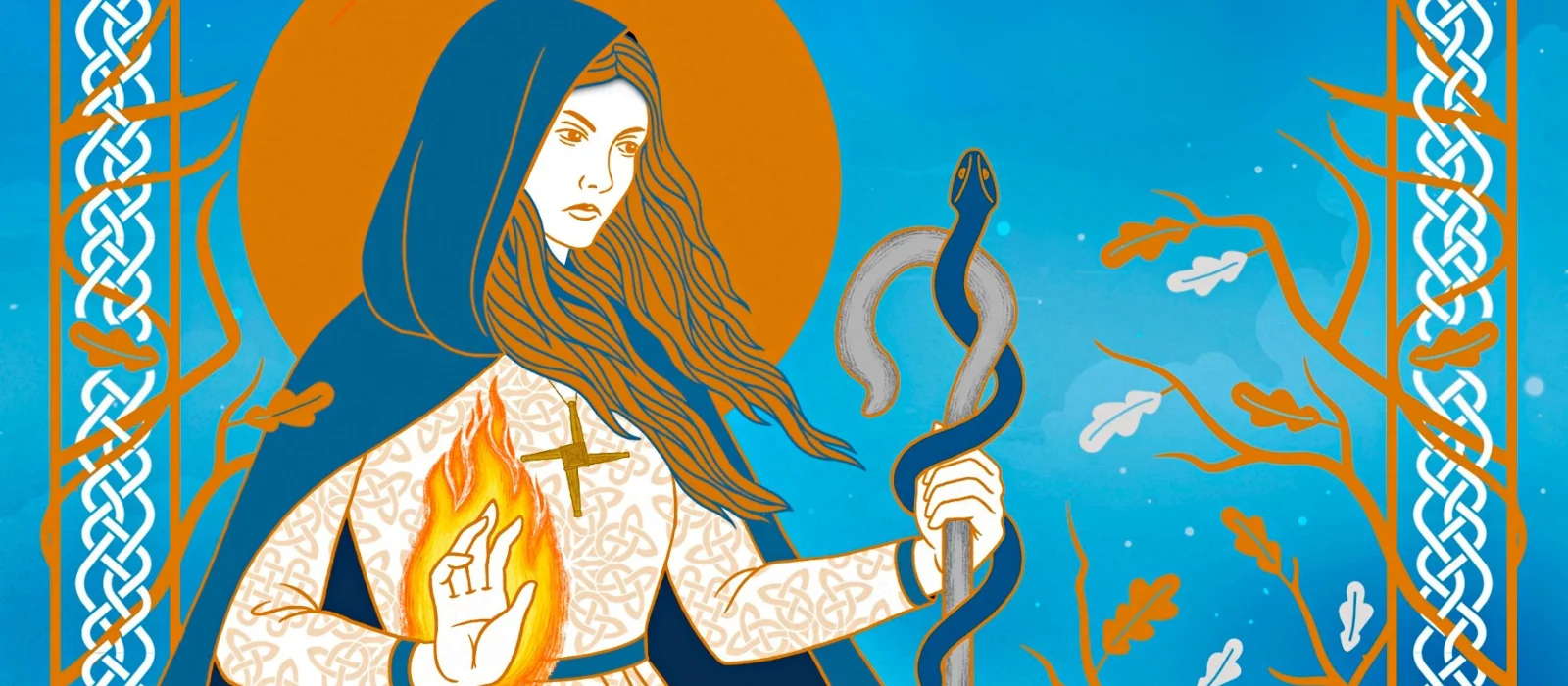
It was somewhat of a relief when I began my research into my latest novel, Brigid. A woman who, in none of the versions of the stories I read, was assaulted. In fact, when threatened with a marriage she didn’t want, she prayed to be monstrously ugly so that when her husband-to-be laid eyes on her, he ran screaming. After which, she became a nun and swore off men for life.
That didn’t mean that Brigid didn’t have to deal with men. But hers was a battle of wits and politics, not strength. One of gaining and holding power, but without the tools available to men. She didn’t lead armies or wield a sword. Her weapons were intellect, compassion and a spectacular unwillingness to be patronised.
My favourite story about Brigid is the very first I heard about her. When offered a plot of land the size of her cloak, she didn’t sulk or challenge the king to single combat. She simply instructed four of her sisters to each take a corner of her cloak and run. And they ran. And as they did, the cloak grew and grew and grew, ‘til it covered the whole of The Curragh. A lesser hero would have demanded blood. Brigid settled for real estate.
After centuries of being overshadowed by Ireland’s other patron saint, Patrick, Brigid is having her time in the sun. She has become a symbol of women’s resistance and power. Of a new kind of leadership, one which does no harm, but takes no sh*t.
Hers are stories of miracles. Miracles as domestic as turning bathwater into beer and as grand as raising up the waters of the Liffey to protect her convent. She healed the sick and gave everything she had to the poor. She was kind to even the weakest of animals. And when one of her sisters came to her pregnant, Brigid performed what can only be seen as an abortion, allowing the sister to continue her life within the order.
For all her gentleness, Brigid was not above retribution. When her brother tried to marry her off again, she made his eyes explode. And a dishonest salt seller was crushed under the weight of his own goods. Brigid is, as the storyteller Sorcha Hegarty of Candlelit Tales told me, the patron goddess-saint of boundaries.
We are only beginning to rediscover the depth and complexity of Brigid. After centuries of being overshadowed by Ireland’s other patron saint, Patrick, Brigid is having her time in the sun. She has become a symbol of women’s resistance and power. Of a new kind of leadership, one which does no harm, but takes no sh*t.
Like many of the women in Irish myth, Brigid is defined by her liminality. Her story straddles the mythological and the historical. She is the daughter of a pagan chieftain and a Christian slave, a goddess-saint born literally on a threshold. The Morrigan too is a shapeshifter, never fitting neatly into any category. In a world that increasingly wants us to see things in black and white, they both have a lot to teach us about existing in the grey.
Another striking feature of the stories of the women in Irish myth is how they connect to each other, flowing from woman to the next, as though they are shaking hands across the tales. Queen Medb is the instigator and ultimately winner of the Táin, but her victory was only possible because Macha had cursed the men of Ulster to be struck by the pains of childbirth when their need was greatest. One woman’s vengeance became another’s advantage.
The pattern continues as Ireland shifts from pagan to Christian mythology. When St Brigid chose the ground for her great convent, she settled on the very site where the goddess Brigid had been honoured for generations. She does not overwrite the goddess, but rather inherits her place, her authority, her fire.
Sisters support sisters. Mothers protect daughters. Goddesses raise up mortal women. Their stories are less a series of isolated myths than a continuous conversation between women, each amplifying the voice of the one who came before. A mythic network of sisterhood, connected through a shared hope for freedom, which shows us that by working together, women can rise above everything gods and fighting men throw at them.
Brigid by Kim Curran (€16.99, Michael Joseph) is on sale now.
As part of Brigit 2026: Dublin City Celebrating Women, Kim Curran will join Donal Fallon for a special event celebrating the release of her new novel, Brigid, on Saturday, January 31.
Also Read