



It was an episode designed to rile up tensions and suspicions, but no one expected it to be quite this emotional, writes Roe McDermott.
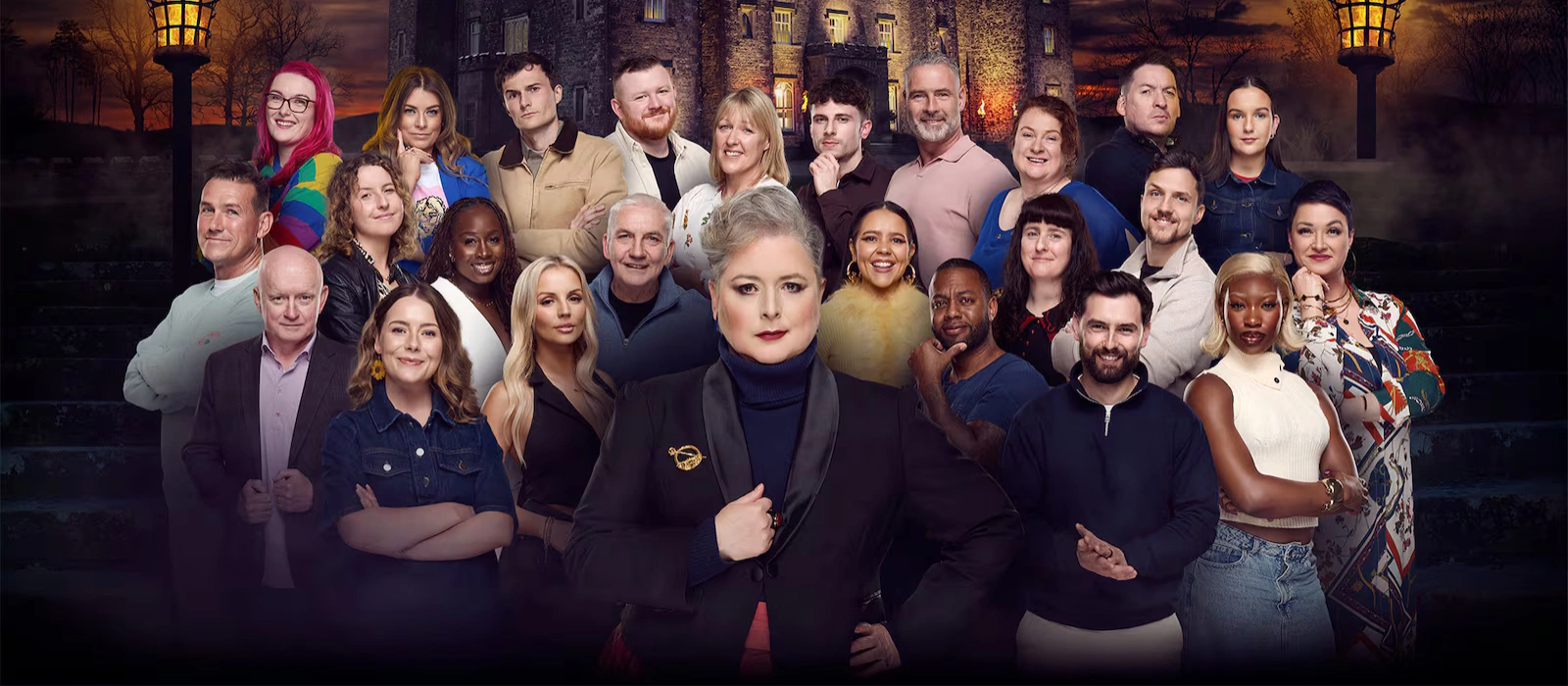
On last night’s The Traitors, the mission saw the group ordered to individually pick which other player they thought was the least trustworthy, and it was 39-year-old Joanna who received the most votes, despite the audience knowing that she is indeed a Faithful and it’s team favourites Nick and Ben who are in fact scheming behind everyone’s backs.
At the roundtable, Joanna was accused of sowing discord and disinformation between the Faithful – accusations that largely centred on conversations between the women. Joanna slightly misreported a conversation she had with Oyin and Vanessa about Faye, saying Oyin had started a discussion when Joanna herself actually had, which made it seem like she was pitting the women against each other. Watching back, it genuinely seems to have been a miscommunication, with everyone misremembering parts of the exchange. Still, it was enough to put Joanna under fire from Faye, Oyin and Vanessa, with Kelly and Wilkins also suggesting her behaviour was suspicious.
When Joanna was voted out, her departure was the most emotional of the series. Through tears, she declared: “I’m very happy to be going home and to see my family. I said I wasn’t going to cry, and the only reason I’m doing that is because my character was being attacked. I actually hope one of the guys will win it because you’re all mean girls. And I’m a Faithful.”
At her words, the women at the table covered their faces, ashamed and upset, with Kelly whispering through tears, “I don’t want to be here anymore, I don’t like it here.” The internet, in all its usual measured temperedness, immediately took to Twitter (I’m never calling it X – suck it, Elon) and Reddit to lambast all of the women for embracing that most unacceptable form of womanhood: a mean girl.
But… were they mean? Or were they simply doing what every player on The Traitors has done – building theories, testing hunches, and sometimes grasping at flimsy evidence in the hope of smoking out a Traitor? Why is it that in a series literally built on distrust, strategy, and suspicion, women’s gameplay is coded as “mean”?
I’m not going to pretend that I don’t get emotionally involved in The Traitors or that I would be able to play and not take it personally. Without spoiling it for anyone who hasn’t watched the UK seasons, there is one player who obviously had a crush on another and completely trusted them, only to be blindsided and betrayed. I was crushed for them when the truth came out, and the reveal still haunts me. I even find myself worrying about their ability to trust a partner afterwards – which is an over-invested and possibly even patronising parasocial projection on my part, but shows how deeply I empathised with the feeling of being lied to in a context where betrayal is the whole point of the game.
I love The Traitors, have watched several of the international versions, have spoken about it endlessly with my friends, and know myself well enough to admit that playing it on national television—forming friendships and then discovering someone I liked was lying to me—would utterly f*ck with me. So I’m not going to play the “It’s just a game, leave your emotions at home!” card. My emotions are big and heavy and come with me everywhere. It’s why my handbags are so ludicrously capacious.
And so I empathise with Joanna. She is about a decade older than the other women who voted her out, often spoke about her experience as an immigrant in Ireland trying to find belonging, and admitted to feeling like she had no real friends or alliances in the game. This stood in stark contrast to the bromance between Nick and Ben, or the firm female friendships like Kelly and Amy’s, or Vanessa and Oyin’s. To be surrounded by strong alliances when you feel isolated must be incredibly difficult, especially when cut off from family and friends for weeks. Joanna spoke about this isolation strategically, but emotionally, it also just looked lonely.
In that space, being accused of lying when you believe you’ve been clear and forthcoming would feel personal and painful. I get Joanna’s reaction, I really do. But taking something personally doesn’t always mean it was personal. Every Faithful who has been banished—there have been many—has been accused of untrustworthiness, with small quirks or offhand comments seized upon as evidence. Joanna, like nearly everyone else (apart from Wil, whose whole strategy seems to be ‘do absolutely nothing’), was moving between groups and reporting back what she heard. Her mistake was in relaying a conversation incorrectly – not maliciously, but imperfectly. She suggested Oyin had asked her who she was voting for, implying Oyin was orchestrating a campaign, when in fact it was Joanna who had asked. A tweet from RTÉ and social media users accused Oyin of lying, when it’s equally plausible she simply forgot the exchange and accurately denied starting it.
A miscommunication, a seed of distrust, a theory, banishment. A tale as old as The Traitors itself. So why then is this banishment being followed up by national conversations calling the female players ‘mean girls’?
We already know the answer. Women are expected to be ‘nice’ and held to different standards than men. Where a man is described as calculated, confident, or authoritative, a woman showing the same traits is branded manipulative, sly, or duplicitous. The very qualities valorised in male contestants—confidence, decisiveness, control—are turned into flaws when embodied by women.
This isn’t new. We’ve seen it across reality TV for decades, from Big Brother to Survivor to Love Island: men can shout, scheme, or dominate, and the language used to describe them is usually about strength, intellect, or authority. Women, when they do the same, are accused of bitchiness, backstabbing, cattiness. We also see this in the professional realm or even Presidential races, where men are assertive, but women are bossy. Men are strong leaders, women are shrill, bitchy harpies. Men can brag about sexually assaulted women and still get into office, while women are criticised for not being ‘likeable’ enough. In other words, behaviour is never neutral – it is filtered through a gendered lens that dictates who is allowed to be strategic, and who is punished for it.
Thankfully, some of the men on the Irish version of The Traitors have been called out for their behaviour and rhetoric, including their damaging categorisation of some men as ‘alpha’ and some as ‘beta’ (groan), and Eamon’s use of absurdly gendered language on The Traitors: Uncloaked, where he repeatedly said that fan favourite Paudie needed more “testicular fortitude” and that he needed to grow some “liathróidí” – all deeply immature language rooted in a rigid idea of masculinity. Nick and Ben were also called out by players and audiences alike for saying that they could “control” Traitor Katelyn, with Amy in particular calling out the patronising misogyny behind the sentiment. The men apologised, and the game moved on.
But here’s the contrast: the men’s missteps are critiqued as individual moments, while the women are branded wholesale as “mean girls.” The insult sticks, not because of what actually happened, but because it taps into a cultural archetype so deeply ingrained it becomes shorthand for female wrongdoing regardless of context.
The ‘Mean Girl’ accusation is doing a very particular kind of work here. It is not just saying that women were unkind, or even wrong. It’s invoking a whole cultural mythology of female cruelty: Regina George in Mean Girls, the cliquey playground bullies, the office whisper networks where women supposedly undermine each other instead of lifting each other up. The phrase doesn’t just describe a moment of tension; it drags with it decades of stories that have cast women’s conflicts as uniquely toxic, uniquely shallow, uniquely destructive.
And it obscures the context – The Traitors is literally a game about suspicion, accusation, and betrayal. Everyone lies. Everyone manipulates. Everyone casts doubt. Yet when women do it, they are reduced to high school caricatures rather than recognised as strategists or players.
And crucially, “mean girl” doesn’t just critique – it cages. It tells women they must play soft, conciliatory roles even in a format designed for suspicion and betrayal. We’ve seen it this season: if a woman cries, she’s too emotional (Faye); if she calculates, she’s manipulative (Katelyn); if she challenges, she’s aggressive (Vanessa). It’s also important to note the racial dynamics at play here: Vanessa and Oyin are both Black women, and Black women disproportionately face accusations of being angry or aggressive compared to white women. The question of whose behaviour is read as mean versus neutral is rarely free from gendered or racial bias. These tropes lock women into an impossible bind: they must play, but not too hard; strategise, but not against another woman; survive, but gently, sweetly, selflessly.
Joanna’s parting words make this sting all the more. That she herself reached for the “mean girl” label shows how deeply it has sunk into our cultural vocabulary, to the point where female conflict can only be articulated through the language of female rivalry. Her departure was no longer just another casualty of The Traitors’ mechanics – it became a morality tale of women betraying women.
But perhaps the real betrayal lies in our cultural insistence on recycling this script. Men on The Traitors can posture about control, masculinity, or dominance, and while some are called out, the label that sticks – the one that dominates headlines and comment threads – is “mean girls.” That’s the one that sets like concrete.
Have we so quickly forgotten that mere episodes ago, Ben and Nick – while still Faithfuls – decided to unilaterally turn on Faithfuls and kick them out one by one, starting by ganging up on Andrew, quite literally without cause. They thought they were deliberately banishing a Faithful to serve their own agenda and ganged up on a man for being too quiet, not “alpha”. But no-one’s calling them “mean”. Because “mean boys” isn’t a label we attach to men’s behaviours, it’s only a mechanism we use to judge and control women’s.
This isn’t to say women should be beyond critique in reality TV. But when the same behaviours are judged by entirely different moral codes, we need to name it. The “mean girl” archetype doesn’t just sting – it narrows women’s choices, keeping them trapped in a double bind where any deviation from “nice” is punished.
The irony is that The Traitors could be a rare space where women are celebrated as strategists, tacticians, even villains in their own right – roles long reserved for men. And yet, cultural commentary drags them back to the high school cafeteria, whispering “you can’t sit with us.” It’s also notable that we’re nearly at the end of this season of The Traitors and not one woman has been recruited to be a Traitor, showing the subtle but deeply ingrained assumption that women can’t, shouldn’t be, or wouldn’t want to be in a position of power, strategy and pantomime villainy.
Until we learn to see women’s gameplay as just that—gameplay—we will keep punishing them for refusing to be endlessly nice, endlessly nurturing, endlessly palatable. And maybe that’s the real treachery: not what happens at the roundtable, but what happens when we, as viewers, let our gendered scripts do the accusing for us.
Also Read