









The racist WhatsApp group chats from conservatives in Ireland show that bigotry is the point
The leaks from private group chats of young members of political parties in both Ireland and the US show not that a few individuals harbour secret hateful thoughts, but that hate itself is being used as a means of social cohesion, and that we have a political culture that too often treats the exposure of bigotry as the problem rather than the bigotry itself, writes Roe McDermott.
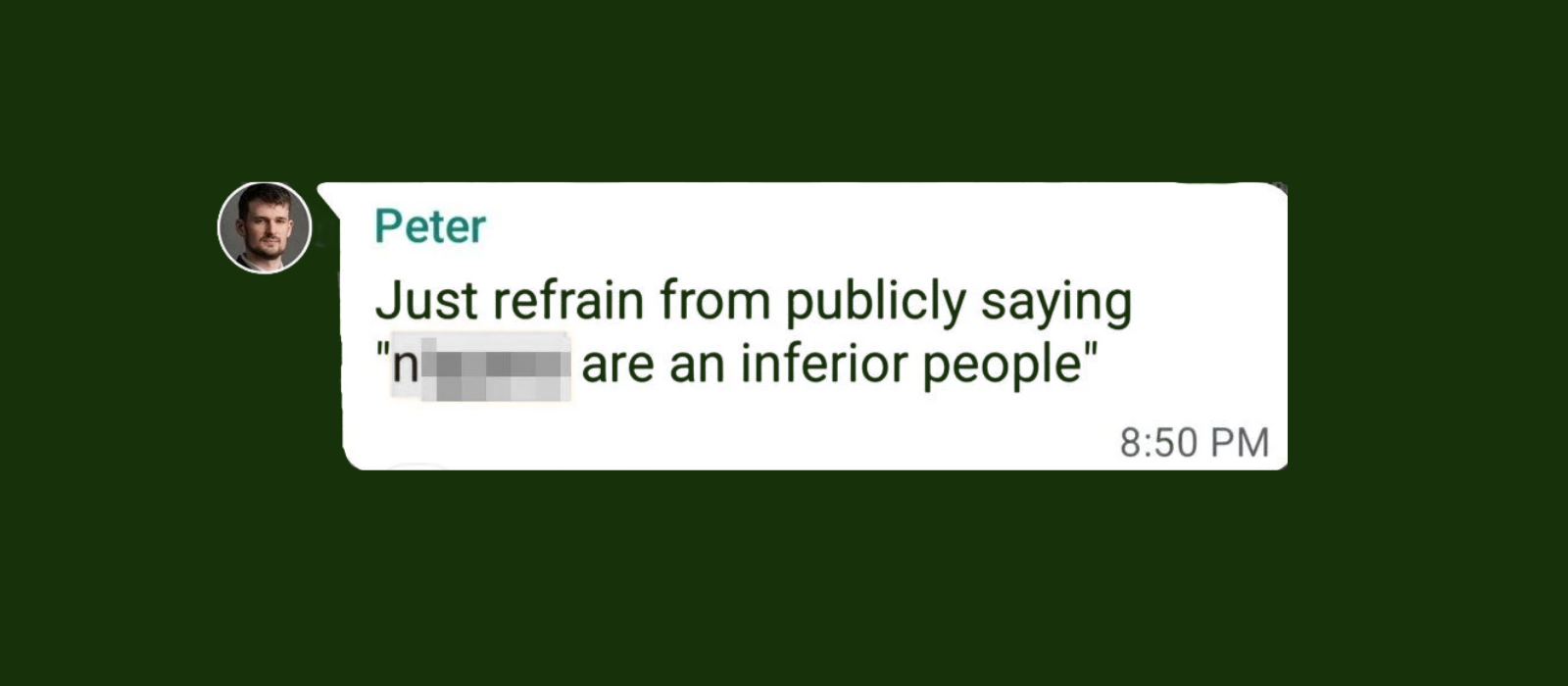
In the space of a few days, two stories on opposite sides of the Atlantic sketched the same troubling outline. In the United States, months of leaked messages from a Young Republicans group chat revealed a steady thrum of racist and antisemitic slurs, lurid jokes about rape, and flippant invocations of gas chambers – the sort of ‘edgelord’ repertoire that has become native to far-right corners of the Internet and has now seeped into the mainstream of conservative youth politics. The fallout was immediate and uneven: while party organisations and many elected Republicans condemned the exchanges, Vice President JD Vance framed the uproar as performative pearl-clutching, insisting that ‘kids do stupid things,’ downplaying the gravity of the language and redirecting attention to unrelated Democratic misdeeds. In Ireland, Ógra Aontú – the youth wing of Aontú – confronted its own clandestine WhatsApp groups where some members traded racist language and antisemitic memes. Here, the party leadership moved to suspend and then dismiss several involved, as one prominent young figure issued an apology couched in the familiar cadence of disavowal, saying the remarks did not reflect his true beliefs or character.
Different jurisdictions, different parties, the same choreography: grotesque ‘jokes’ in private, hurt and harm in public, and a political culture that too often treats the exposure of bigotry as the problem rather than the bigotry itself.
The recent exposure of racist, antisemitic, and violently misogynistic group chats of these conservative groups has reignited a familiar defence: that these messages were ‘just jokes,’ ‘just banter,’ ‘just edgy humour among friends.’ The individuals involved insist that because the conversations took place in private group chats rather than from podiums or press releases, their words have no bearing on their beliefs, values, or fitness for public life. The message is, as always, that the racism was somehow only real if it was meant seriously (according to the speaker); if it was shared publicly; and that only the speaker – not the people harmed by their words – gets to decide whether it counts as harm.
This denial of responsibility is not new. It is the same logic used in so-called ‘locker room talk’ about women; the same logic that fuels comedy routines premised on the humiliation or dehumanisation of already marginalised groups; and the same logic that allows people to participate in systems of dominance while insisting they personally bear no guilt. It is a logic that promises the freedom to demean others without ever being seen as the kind of person who would demean others, and thus faced with consequence.
The men in these chats did not accidentally stumble into racism or antisemitism. They were not simply repeating jokes they did not understand. Their racist humour was deliberate and strategic: a tool of social bonding, a measure of ideological loyalty, a test of who belongs and who does not. As internet culture scholars and former members of these circles have pointed out, these jokes function less as humour and more as ritual. The increasingly shocking statements – the slurs, the gas chamber references, the violent misogynistic fantasies – exist to display one’s commitment to the group and one’s willingness to defy the norms of empathy and decency that hold societies together.
The cruelty is not incidental. The cruelty is the social glue. The cruelty is the point.
Yet when these private chats become public, when their words are traced back to their employers, their parties, their communities, these very same individuals insist that none of it reflects who they are. They declare themselves misunderstood. They call critics hysterical. They complain that today’s culture is ‘too sensitive’ to handle a joke. They claim they were merely ‘playing along,’ merely ‘caught up in the moment,’ merely ‘testing the boundaries’ of humour. They frame themselves as victims of overreaction, as though the greatest harm is not the racism or antisemitism itself, but the social discomfort of being held accountable for it. And they do not simply deny the content; they attempt to step back into the world of ‘good men from good families,’ men with professional ambitions and political promise, expecting colleagues, voters, and the public to politely collude in forgetting that another version of them has been clearly documented. They ask us to believe that there is a clean line between the jokes they tell in private and the values they hold in public life, even though the jokes only function because they are recognisable as expressions of hierarchy, disdain, and power. They want to enjoy the thrill of transgression without accepting the moral identity of the transgressor. They want to demean without being known as demeaning. They want the pleasure of cruelty without the stain of cruelty. And they count on the rest of us to pretend that such a split is possible.
And crucially, this performance relies on institutions being willing to play along. In the United States, party leaders issued statements of disapproval, yet the broader message from figures like JD Vance was unmistakable: the real problem was not the racist and antisemitic remarks themselves, but the fact that someone had the audacity to object to them. His insistence that these were merely ‘stupid jokes’ from ‘young people’ reframed deliberate, targeted dehumanisation as a harmless developmental phase – an indulgence to be forgiven, not examined. In Ireland, Aontú moved quickly to distance itself from its youth wing, yet even there, the response focused more on rooting out the embarrassment than on interrogating how such attitudes had flourished within its ranks to begin with, and what about their party attracts people with such vile and degrading views of others.
The instinct in both cases is to minimise, to smooth over, to move on – to treat bigotry as an unfortunate lapse in tone rather than evidence of a worldview. And whether it is done loudly, like Vance’s public shrug, or quietly, through organisational silence, the effect is the same: those involved learn that the door back into respectability remains open, that the damage is not to those harmed by the speech, but to the reputations of those who said it. The lesson is clear: racism carries few material consequences – only the fleeting inconvenience of a news cycle.
Their racist humour was deliberate and strategic: a tool of social bonding, a measure of ideological loyalty, a test of who belongs and who does not.
This same hypocrisy echoes throughout the broader culture surrounding these conversations. The very politicians and commentators who insist that racist, antisemitic and threatening speech in private chats is ‘edgy humour’ or ‘free thinking’ are often the same voices demanded the firing and silencing of anyone who dared to criticise Charlie Kirk for his own deeply harmful views and actions, or campaigned for Jimmy Kimmel to be taken off the air for a very mild joke about Trump. They are the same voices championing comedians like Dave Chappelle and Ricky Gervais who build entire specials around mocking trans people, insisting these men are being ‘silenced’ even as they sell out arenas and command international platforms. Their speech is framed as bravery, authenticity, truth-telling, while speech that challenges or criticises them is framed as censorship, hysteria, or moral tyranny. This shows the hypocrisy at the heart of their arguments about free speech and hard: the distinction between acceptable humour and unforgivable offence is not drawn along lines of harm or ethics. It is drawn along lines of loyalty.
What these private group chats reveal, in both countries, is not that a few individuals harbour secret hateful thoughts, but that hate itself is being used as a means of social cohesion – a way to signal belonging, to prove allegiance, to test who is willing to dehumanise and who will refuse. The expectation is that these spaces remain sealed off from public judgment, as though language loses meaning when spoken behind a screen. But private bigotry does not stay private. It informs how people choose candidates, write policies, adjudicate complaints, run workplaces, police streets, and treat neighbours. The jokes are not separate from the culture. They are the culture that allows discrimination, exclusion, and violence to be seen as natural, inevitable and even justified. There is no special chamber where bigotry becomes harmless.
Just as private sexualised conversations about women create the cultural foundation that enables harassment, assault, and the denial of women’s autonomy, private racist humour lays the foundation for racial profiling, discriminatory laws, the rise in attacks on immigrants, and the quiet daily humiliations inflicted on those who are treated as less than fully human. Jokes become beliefs, beliefs shape choices, choices shape institutions. The distance between ‘joking about gas chambers’ and supporting political violence is not as vast as those who tell these jokes would like us to believe. One is the rehearsal. The other is the performance.
This is the reason that there is a direct pipeline from so-called ‘edgy’ comedians and podcasters who champion ‘taboo’ jokes or ‘edgelord’ humour to far-right extremism. For years, figures like Joe Rogan and his ilk claimed they were ‘just making jokes’ and that they were pushing back on ‘woke’ censorship in comedy in harmless ways, defending their right to make jokes about marginalised people under the guise of the jokes being apolitical and not representing any actual bigotry or worldview that prioritises the comfort and privilege of straight white men. And yet over the past decade, we’ve witnessed exactly how those spaces have become a breeding ground for misogyny, racism, white supremacy and a gateway to far-right extremism. Jokes are the entry point, the everyday normalisation of bigotry and degradation, which then becomes cemented and transmutes itself into worldviews, promoting misogyny, racism, patriarchy and gets fascist leaders elected because they promise to maintain and protect the social hierarchy that keeps these white men who are ‘just making jokes’ at the top.
The fantasy these men cling to – the fantasy that they can say racist things without being racist – is simply the fantasy of power. It is the fantasy of being able to harm without consequence, to demean without consequence, to participate in systems of domination while exempting oneself from moral judgment. It is the fantasy of being allowed to build the world, but never being held accountable for the world one builds.
There are no spaces where racism is harmless. There is no form of bigotry that is ‘just a joke.’ If you express racism when you think the world is not watching, that is who you are. And the society we hope to build – equal, plural, safe, and free – cannot be built by people who believe cruelty is funny.
The bigotry is not accidental. The bigotry is the point.
Also Read