











The House of Guinness: Ireland’s real-life Succession?
Drawing on her genealogy work at the Irish Family History Centre at EPIC The Irish Emigration Museum, Fiona Fitzsimons explores how the Guinness dynasty blended family, business, and power.

Today, Guinness is a global brand, its black-and-cream pint as instantly recognisable as the Coca-Cola bottle. But behind the froth lies something closer to a real-life episode of Succession.
From the outset, the family understood that survival depended on more than good brewing. They avoided the rigidity of primogeniture, where the eldest son inherits everything, instead choosing successors by aptitude and interest. That didn’t mean the system was egalitarian: in the 19th century, daughters could never have succeeded to the business. Still, it was a pragmatic strategy that was the best guarantee of competence at the top.
The Guinness family were dynastic in another sense. As a family historian, when I investigated their genealogy, I found a lot of cousin-marriages, keeping resources within the family. This is the kind of strategy usually adopted by royalty/aristocracy, families that take a long-term view and think in centuries rather than decades. It would seem that even before the Guinnesses achieved their immense wealth, they were thinking ahead.
Guinness: the early generations
The new Netflix series, House of Guinness, opens in 1868. It’s a curious entry point, bypassing the first three generations that laid the foundations of the Guinness fortunes.
Arthur Guinness I, the founder, signed the now-legendary lease on St. James’s Gate in 1759. He had ten children; the eldest went into the Church, leaving the brewery to a younger son with a taste for business. He started the family tradition of civic involvement – he was governor of the Meath Hospital; and philanthropy, he funded Ireland’s oldest school, St. Patrick’s Cathedral Grammar School, founded 1432.
By the second generation, the family was dabbling in politics. Arthur Guinness II ran for Parliament against Daniel O’Connell, the “Liberator.” Arthur was a complex man, he supported both Catholic Emancipation and the Act of Union. Rivals sneered that Guinness made “Protestant porter”, a jab that only sharpened the family’s determination.
It was Benjamin Lee Guinness, Arthur’s grandson, who transformed the brewery from ambitious family concern into an industrial juggernaut. In the 1850s, he adopted a ruthless new strategy: he undercut rivals on price, driving them to collapse, then acquired their operations. The plan worked spectacularly. From the 1850s until his death in 1868, Guinness grew from Ireland’s largest brewery to the largest in the world.
Benjamin Lee Guinness continued the family’s commitment to cultural patronage. He funded the restoration of St. Patrick’s Cathedral and Marsh’s Library in the heart of the old city. He hosted the Great Exhibition of 1865, an international event designed to showcase Irish arts, manufactures and industry, and attracted almost a million visitors. In April 1867, the year before he died, his contribution to Dublin’s public life was recognised with a Baronetcy.
Benjamin Lee Guinness married his first cousin, Elizabeth Guinness, and had four children who would shape the Guinness identity in the modern era.
The children of Benjamin Lee
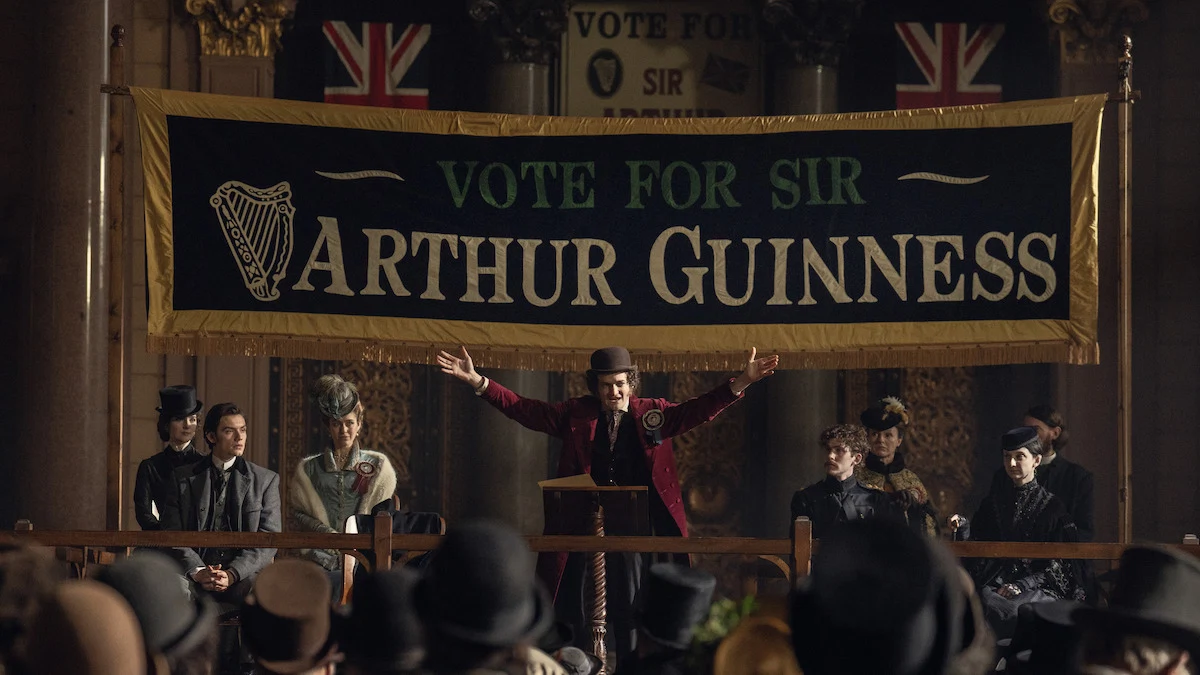
House of Guinness picks up the story in 1868, following the death of Benjamin Lee Guinness, and considers succession within the family business.
The eldest surviving child was Anne Lee Guinness 1839-1889 (actor Emily Fairn), and in her story there is a quiet irony. For centuries, brewing was considered women’s work. But by the Victorian era, women were expected to confine their enterprise to smaller concerns, shops, schools, charities. Anne couldn’t take an active role in the family business, instead she married William Conyngham, 4th Baron Plunket, and withdrew into a world of land and lineage.
Arthur Edward Guinness 1840-1915 (actor Anthony Boyle), the eldest son, inherited his father’s title and became Baron Ardilaun. In the family’s telling of their own story “there is nothing to suggest that Arthur had…[an] appetite for a career in the brewery.”* He used his wealth to further develop the family tradition of civic-mindedness, and bought up the private keys to St. Stephen’s Green in Dublin, threw open its gates, and gifted the park to the public. He also funded the extension of the Coombe Hospital, an act that transformed maternity care for working-class women in the city. Arthur married Lady Olivia White, daughter of the third earl of Bantry, but there were no children of the marriage.
Benjamin Guinness the younger 1842-1900 (actor Fionn O’Shea) chose adventure over commerce. He received an officer’s commission in the Royal Horse Guards, serving in India and Afghanistan in the 1870s, at the height of the so-called ‘Great Game.’ He married Lady Henrietta St. Lawrence, daughter of the third Earl of Howth, and settled into aristocratic life with three children.
But it was the youngest son, Edward Cecil (Ned) Guinness 1847-1927 (actor Louis Partridge), who carried the Guinness dynasty to its zenith.
Ned Guinness: From Brewer to Plutocrat
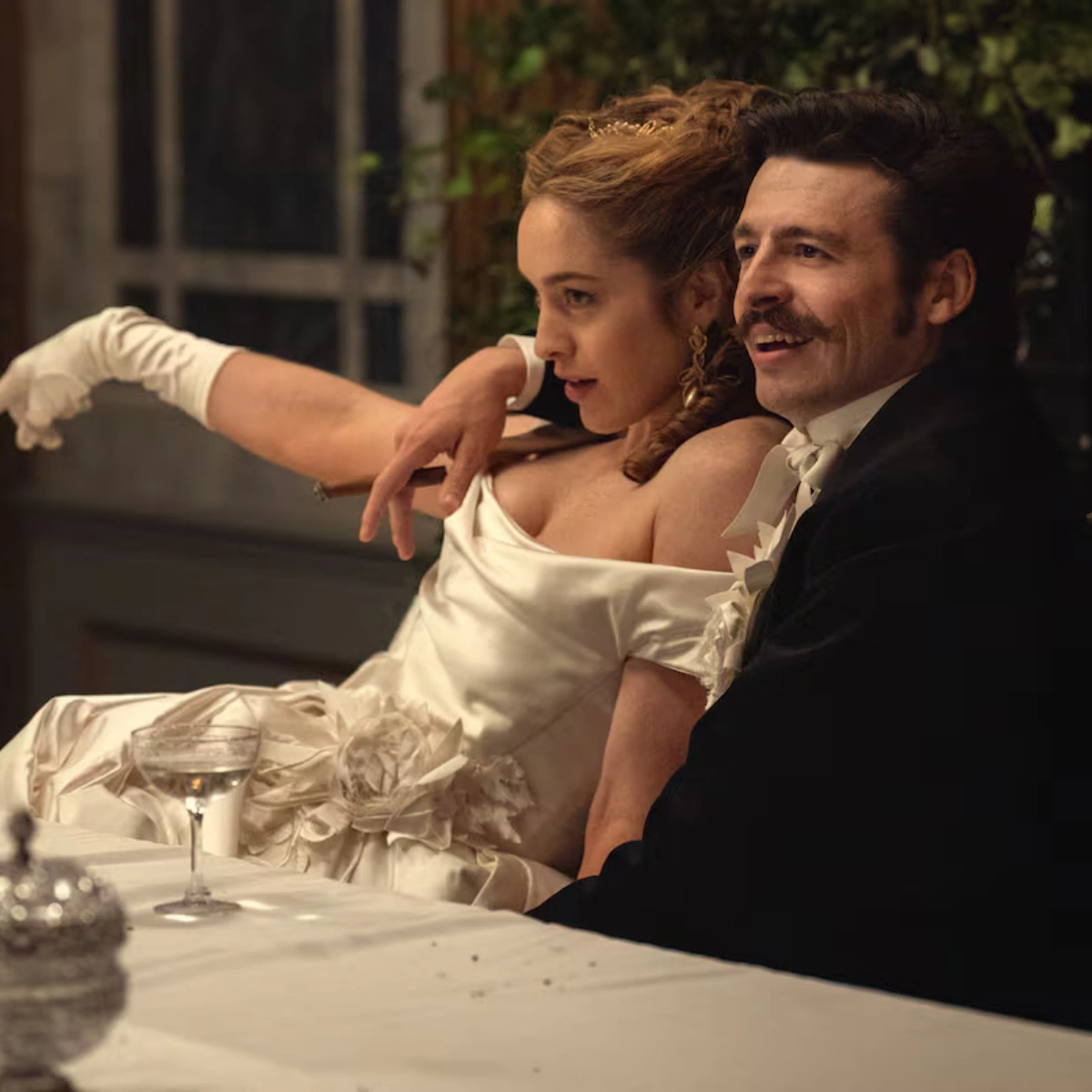
Ned Guinness was the fusion of brewer, aristocrat, and benefactor. He is remembered within the family as “quick, sharp and decisive” with a head for detail. In the 1860s, he joined his brother Arthur in the brewery and quickly showed his mettle. In 1876, at just 29, he bought out his brother’s share for the then staggering sum of £600,000, a fortune in its own right. Over the next decade, he expanded exports, modernised operations, and built on the work of the generations that preceded him.
In 1886, Ned floated Guinness on the London Stock Exchange. Overnight, he went from brewer to plutocrat, one of the richest men in Britain. At the height of his power, and still only in his forties, he walked away to devote himself to philanthropy.
Ned Guinness continued his family’s connection with St. Patrick’s Cathedral, funding the restoration of the choir, refitting the bell tower, and purchasing the land to create a new park. In 1890, he founded the Iveagh Trust, to fund slum clearance and provide affordable housing in Ireland and Britain. In central Dublin in 2025, there are still several original buildings in the area around St. Patrick’s Cathedral and Christ Church Cathedral, managed by the Trust.
In 1873, Edward Cecil Guinness married his cousin Adelaide Maria Guinness (1844-1916). Together they had three children: Edward Cecil, later known as Rupert, born 1874; Arthur Ernest, born 1876; and Walter Edward, born 1880. When each of them married, their father bestowed a staggering gift of £5 million each. It was a gesture that symbolised a generational shift. The Guinness dynasty was moving from the world of hard-driving industrialists into the realm of playboy aristocrats, a transition gilded with glamour and shadowed by tragedy.
Rupert Guinness, the eldest, married Lady Gwendolene Onslow and carried on the Iveagh title.
Arthur married Chloe Russell and they had three daughters, the fabled “Golden Guinness Girls”, Aileen, Maureen and Oonagh.
The youngest son, Walter E. Guinness entered politics and was elevated as Baron Moyne. In 1944, he was assassinated in Cairo by the Stern Gang, a Zionist organisation.

So what should we expect from the House of Guinness series?
I’ve crossed paths with the Guinnesses before, while researching an RTÉ documentary, so I know the family dynamics and the real characters who shaped their story. How will they be shown in the new Netflix series, House of Guinness? Having worked as a historical adviser on film and television productions, I’ve learned that facts are often trimmed, so as not to get in the way of a good story. But if this one delivers the intrigue, rivalries, and dynastic manoeuvring of a real-life Succession, then I’ll happily binge every episode, and hope it’s renewed for another season.
About the writer: Fiona Fitzsimons is a Director of the Irish Family History Centre at EPIC The Irish Emigration Museum. Since 2005 she’s worked with the producers of Who Do You Think You Are?, and after 2008 of Finding your Roots (PBS). She provides historical research and treatments for television and film, with past projects including the Oscar-nominated Albert Nobbs, A Dangerous Fortune (Constantin Television), and the dramas Ripper Street, Penny Dreadful, and Reign (CW Network).
*Guinness: A Family Succession, Arthur E. Guinness, (2025).
Imagery via Ben Blackall/Netflix
Also Read