










By Jennifer McShane
25th May 2019
25th May 2019
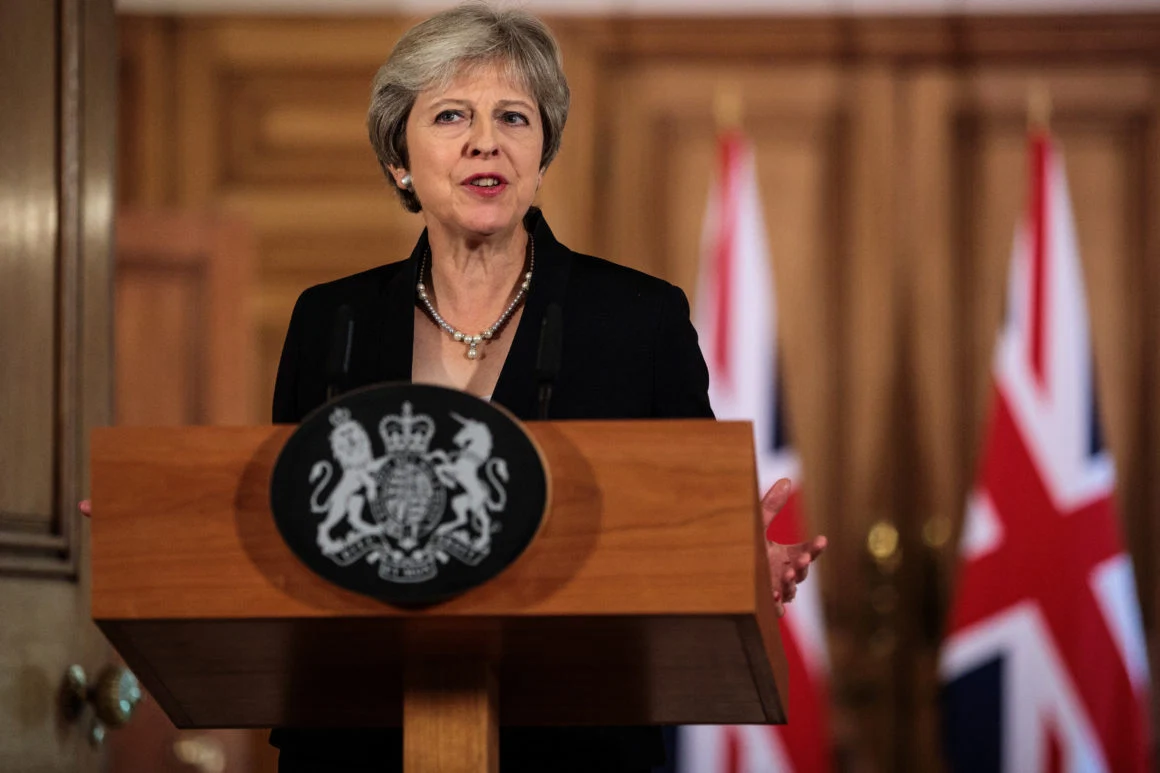
Sexism is still as strong as ever, judging by the one-sided coverage which dominated Theresa May’s resignation, writes Jennifer McShane
There will be plenty who don’t agree with Theresa May and her conservative party politics. Or perhaps anything she has done – or failed to do – up to this point. Plenty who are exasperated at her three failed attempts to get a Brexit deal over the line (though not for lack of trying, mind) and plenty who feel that if she’d “shown more emotion at the beginning, she might not be in this position now.”
That was the line that a female presenter used on Irish radio yesterday as on-the-hour coverage rolled of May’s resignation speech. That was the primary focus, along with the failings of her time in office. Her emotion. The cracked voice as she struggled to regain composure in accepting that she had done all she could as prime minister of the UK – the fate of the country, pre-Brexit to be determined by another.
May broke down as she delivered the final sentences of her speech saying it has been “the honour of my life” to be the “second female prime minister, but certainly not the last.”
Subsequently, her tears were mocked by most media outlets in the UK and some headlines here angled for the same.
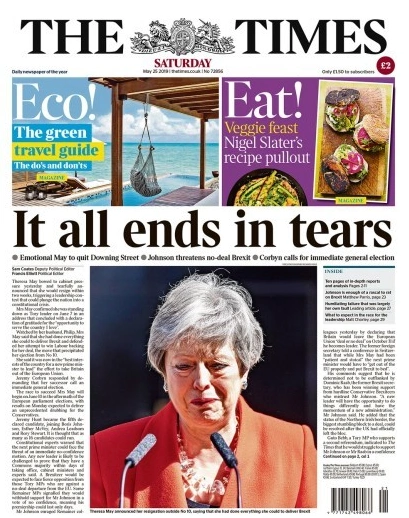
The Times ran with ‘It all ends in tears.’
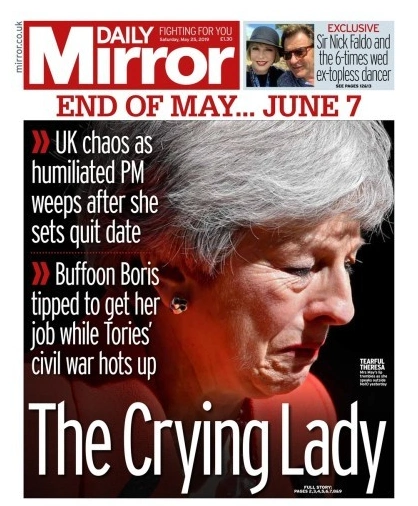
 The Daily Mirror opted for ‘The Crying Lady.’
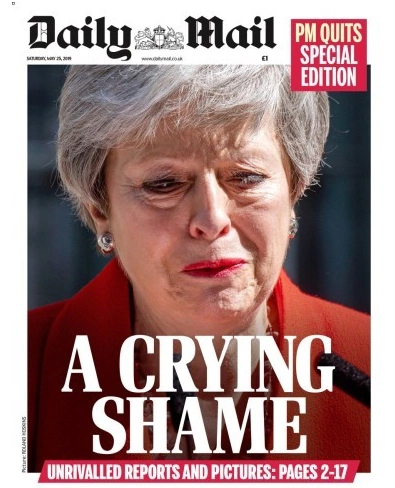
The Daily Mail ran with ‘A Crying Shame.’
She was ridiculed for displaying her tears and yet she was criticised in the same beat for not displaying them sooner, particularly on social media. To mock anyone for crying publically seems a new low. Most outlets single-handedly perpetuated two detrimental female stereotypes; one that is reduced to little more than a quivering mess for shedding tears and the other who was stony-faced for so much of her tenure that this is what ultimately did her no favours.
Double standards
When former British PM David Cameron resigned – pointedly, leaving May to resolve the Brexit mess he left the country in – no such coverage was apparent. But then it’s always been the same, this overt sexism which targets women in any form – particularly public figures.
It was the same when Hillary Clinton and the then-Republican presidential nominee Donald Trump, had everyone talking after a first televised debate; Clinton was elegant, prepared and emerged victorious over a sniffing, floundering Trump yet much of the commentary after it deflected from Clinton’s winning round and focused on the trivial topic of how much she was smiling throughout.
Who told Hillary Clinton to keep smiling like she’s at her granddaughter’s birthday party?
— David Frum (@davidfrum) September 27, 2016
The above tweet resulted in an article where the male writer both questioned and defended his tactless tweet. He painfully pointed out that the same has been directed at men many times before and sure well, Clinton’s smile was so contrived during the first twenty minutes of the debate, that how could one possibly not comment on the fact?
It rarely happens to men, but women are expected to placidly smile all the time and therein was Clinton’s (and subsequently May’s) dilemma: Had she shown up with serious, ice-like composure, she would have been called out for being cold and unfeeling, yet she had been told to smile more by an inner circle for the debate to detract from her “stony demeanour” of previous outings.
In fact, the consensus is that Clinton is rather unlikeable despite the fact that she has achieved a tremendous amount over her successful, decades-long career. In contrast, her husband Bill, despite his very public past mistakes is still considered hugely popular and charismatic by many a US media publication. The same is usually befitting of any female in the public eye. Take Oscar winner and actress, Anne Hathaway. She’s hugely successful and undoubtedly able to run her own empire, yet articles still get written with gross titles such as: ‘Why does everyone hate Anne Hathaway?‘
May’s case was apparently similar. Why didn’t she show emotion when it mattered, is what her critics cry.
She was dammed if she did and dammed if she didn’t, but the response to her tears says much more about sexism and standards in 2019 than it does about May. And that’s not saying a whole lot.
Related Stories



Also Read