








A group of French volunteers just spent 40 days in a cave, all in the name of science
By Sarah Finnan
26th Apr 2021
26th Apr 2021
@christianclot_explorer
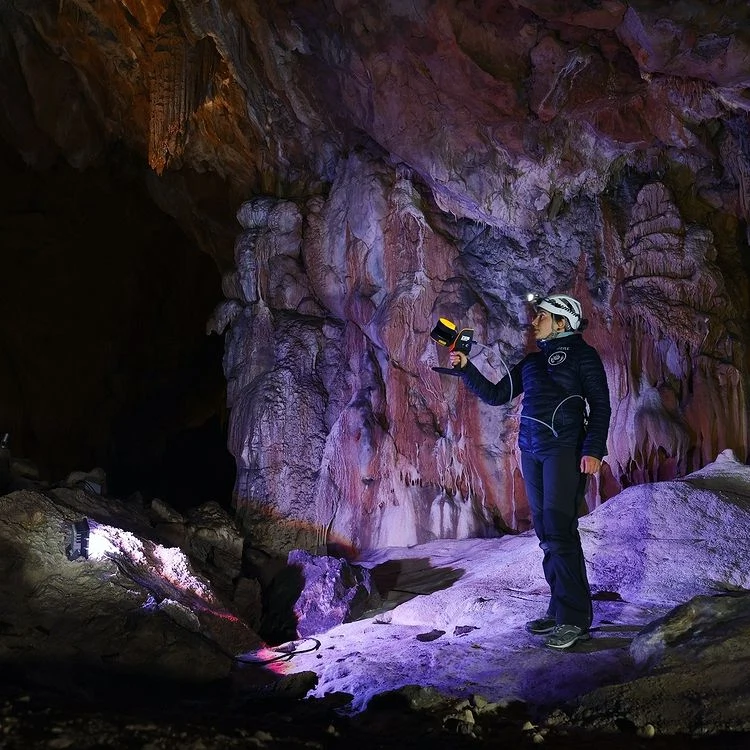
Could you survive 40 days without your phone? How about 40 days without natural light? On Sunday, a group of volunteers emerged from a cave after a 40-day study exploring the limits of human adaptability to isolation.
Most of us can’t bear to put our phone away from the bedside table so we can get a good night’s sleep, never mind hunker down in a cold, dark cave for forty days with a group of strangers in the name of science. A group of 15 volunteers spent 40 days in an underground cave as part a Deep Time experiment that aimed to gather information on how humans react in situations where they lose all sense of time or place.
Taking a couple of moments to allow their eyes to adjust to the light (shielded by special sunglasses for protection), the volunteers emerged from their underground hideaway in much the same way they entered it. Admittedly a little paler than they were just over a month ago, all group members appeared to still be in good health.
Ranging in age from 27 to 50, each of the volunteers forfeited modern living for the experiment’s 40-day duration, with all mobile phones, watches and other such luxuries being handed in at the start of the trial.
Kept at a constant temperature of 12 degrees Celsius and 95% humidity, the group spent the entirety of the experiment within the cave’s confines. Tasked with generating their own electricity by way of a pedal bike, participants also had to draw their own water from a well 45 metres below the earth.
Unable to fall back on new-age technologies or even something as simple as a clock to help them structure their days, they had to rely on factors such as their internal body clocks and natural sleep cycles to guide them instead.
Speaking of what her time in the cave was like, one volunteer Marina Lançon, told BBC News that it “was like pressing pause” on life.
Headed up by French-Swiss explorer Christian Clot, the Deep Time experiment aimed to test how humans respond when put in a situation that makes them lose all sense of time and place. Also inevitably testing the effects of extreme isolation, it’s a topic that has never been more at the fore than in recent months when the continued effects of lockdown and not seeing loved ones have taken their toll on people all around the world.
Commenting on the experiment after emerging from the cave, Mr Clot, said, “our future as humans on this planet will evolve. We must learn to better understand how our brains are capable of finding new solutions, whatever the situation.”
However, while the brain activity and cognitive function of each of the volunteers was analysed before they entered the cave (to use for comparative studies after the 40-days had ended), some scientists were critical of the experiment’s set-up – noting that it lacked a control group, a usually vital component in all scientific studies.
Feature image via @christianclot_explorer
Related Stories




Also Read