





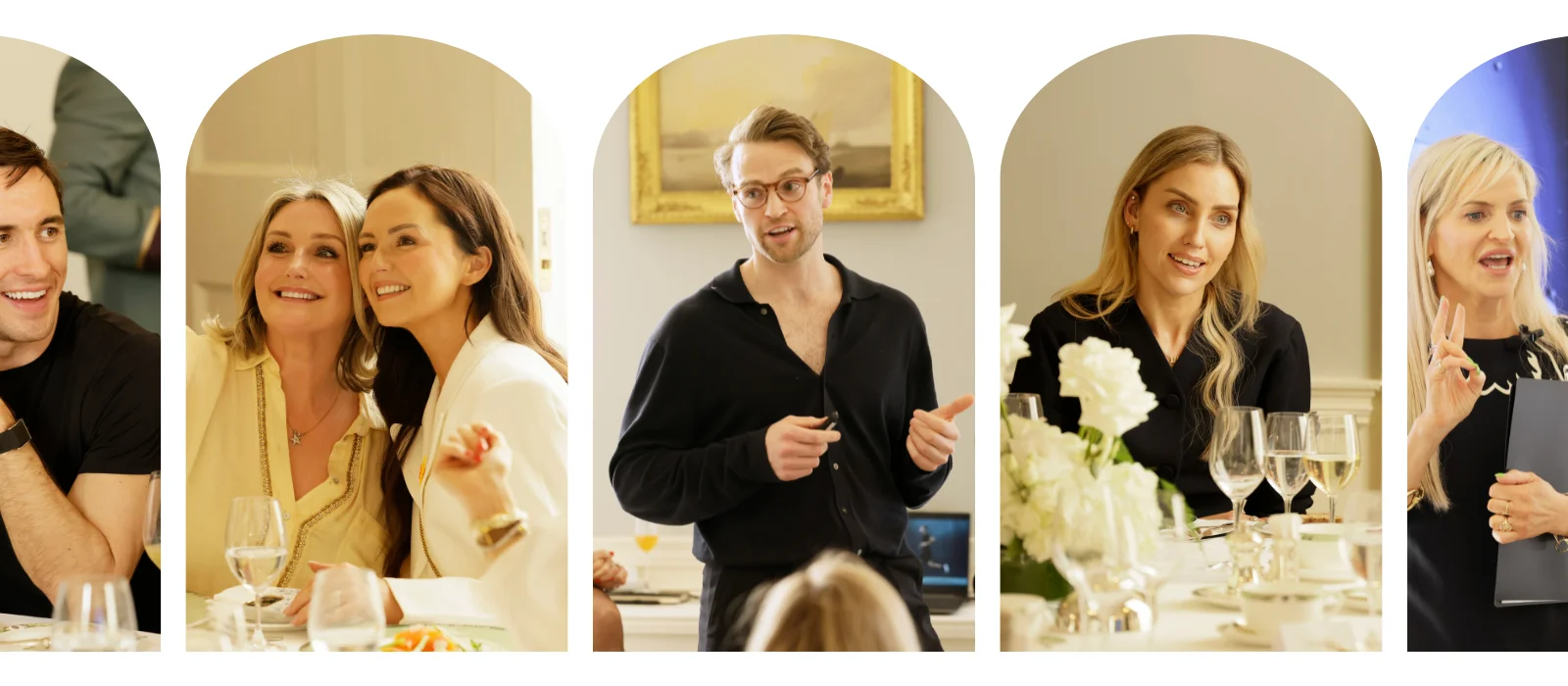







From how to manage mum guilt to sharing a more equal load with your partner, Dominique McMullan illuminates her top takeaways from our recent IMAGE The Motherload event.
Recently, I hosted an IMAGE The Motherload event in which we focused on the power of the pause. We had an incredible panel made up of some of the most wise, connected, authentic and brilliant women I know. We were joined by Rosemary MacCabe, author and podcaster; Daniella Moyles, psychotherapist and author; Danielle Garner, founder of Wildflower Hair Studio; and Tara Rafter, master neurolinguistic programming practitioner and coach.
We spoke about how essential it is for mothers, existing in today’s economic, attitudinal and societal structures, to create moments of pause for themselves – because you can be sure that no one else is going to hand it to us.
There were so many great takeaways, but a few really stuck with me, and I think they might be helpful to any mums out there too.

Mum guilt
When speaking about guilt, the whole panel became animated. Who hasn’t felt a bit of mum guilt? It’s likely, in fact, one of the main blockers preventing mothers from prioritising their own needs. We all agreed that the term “mum guilt” should be removed from the English language entirely, but before we do that, we needed to understand its omnipresence a little bit more.
Daniella Moyles spoke about the internal and external pressure and expectations that we all live with day-to-day that far outweigh what is actually possible to achieve, add to that the narratives we learnt about mothers from watching our own (those women who inevitably never sat down and prided themselves on their business), and of course, we feel guilty. We are caught in an impossible web.
Tara Rafter, a master neurolinguistic programming practitioner who has trained with Gabor Mate, shared some of his wisdom on the topic. Guilt, as Gabor Mate would explain it, is a contradiction in conditioning. We are conditioned to believe that mums don’t sit down, that mums are caring and giving and prioritise the needs of others. However, sometimes, our bodies, or our needs or wants, contradict that conditioning. We might feel guilty for a much-needed sit down with a cup of tea, when we feel we “should” be cleaning the kitchen, for example.
But here is the million-dollar question – how can we rid ourselves of some of that guilt? Or even better – prevent it from arriving in the first place? By understanding our values, says Tara, and what really matters to us most. If it’s a question of a momentarily dirty kitchen or an exhausted, stressed-out mum, I know which one is a priority for me and everyone in my household. I value my peace over the tidiness of my kitchen, and hope you can do so too.
Sharing the load
This brings me nicely to another poignant topic… our partners (and in this case, specifically our male partners) and the split of household tasks and the mental load. A guest in the audience vulnerably lamented a partner who was not pulling his weight, and the strain that was putting on their relationship. I don’t think there was a person in the room who wasn’t nodding in solidarity. This is an ongoing issue for every mother I speak to – as we turn a ship which has been motoring in one direction for hundreds of years.
Rosemary MacCabe, who is home from the States to visit her family, spoke lightheartedly about her father, who, she has discovered on this trip, while well into his 70s, does not yet know how to use his very own washing machine. Danielle Garner spoke about a useful app, ‘SkyLight,’ that she has recently signed her whole family up to. They use this app to divide up family chores, and it has the added benefit of displaying the equality of the spread between Danielle and her husband to her growing sons. We all agreed it was essential that our sons learnt the importance of contributing an equal amount to the running of a home, and that that would be our legacy, if nothing else.
View this post on Instagram
Rage
Rage was another point that came up more than once and was discussed in depth. Rage is not really an “acceptable female emotion”, explained Daniella, but it’s something that all mothers feel at some point, and it’s a normal emotion – just like happiness and sadness. Rage can become a problem, however, when we berate ourselves for feeling it. It’s then that we can get stuck in a downward spiral.
Tara explained that rage usually arises when our boundaries are transgressed. Your rage, or anger, is telling you something. Use it, says Tara, as a fire alarm. Something has happened to make you angry; that needs to be communicated and prevented from happening again. Talk to your partner and family about your feelings and needs for support, and look for ways to manage the underlying issue. And know that it’s not just you.
I could go on, but I know you have things to do.
Ultimately, the power of the pause isn’t about escaping our lives, it’s about making sure we’re actually present for them… messy kitchens and all. So go put the kettle on, guilt-free, because the world needs your well-rested, magnificent self.
Also Read