




Read Julie Bates’ essay in PVA’s new collection, ‘As if nothing could fall’
Paper Visual Art’s fourth essay collection takes us through distant vistas and past worlds, monolithic structures and forgotten ideas. We’ve got an exclusive extract of Julie Bates’ essay, Holiday Inn.
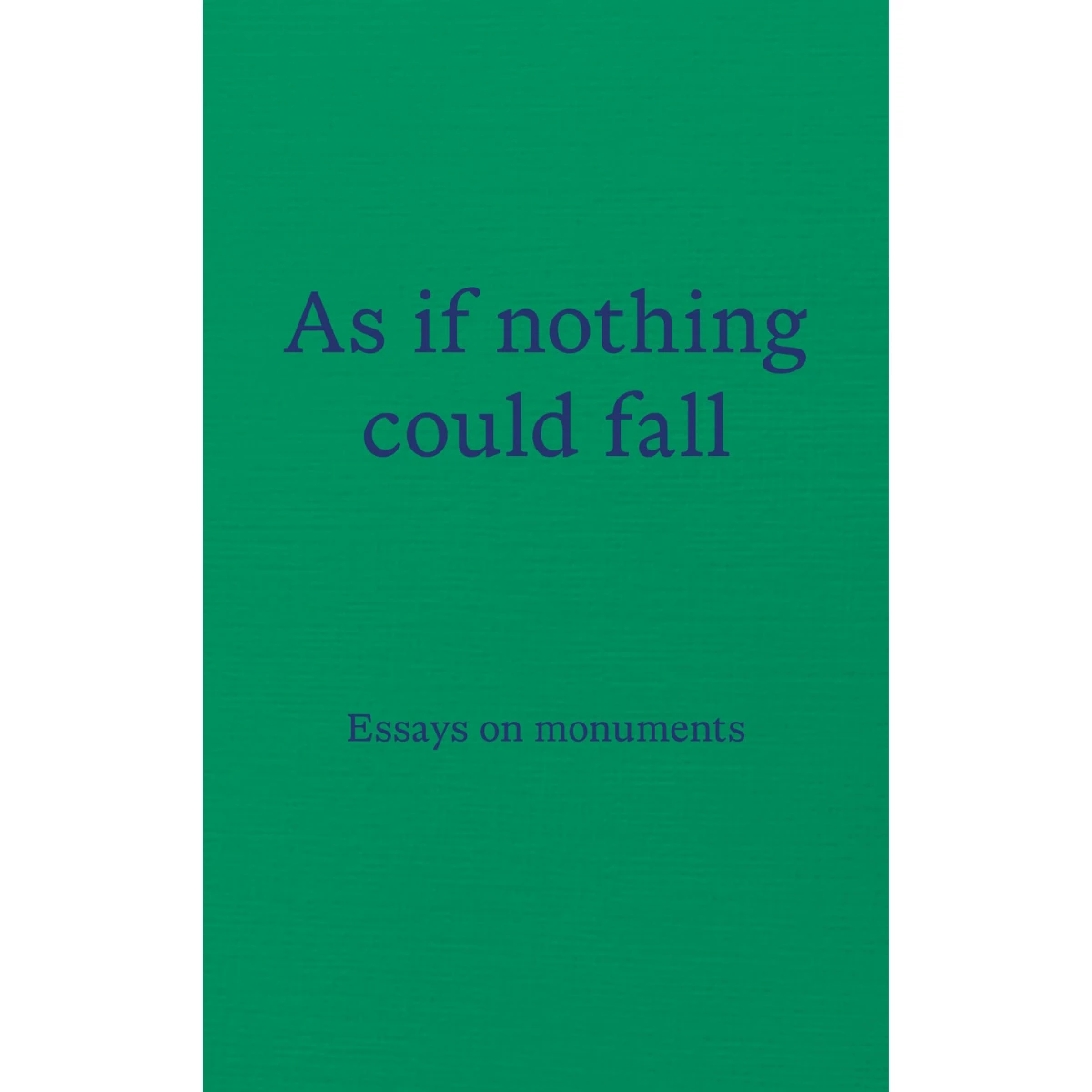
The fourth in PVA’s series of non-fiction collections, As if nothing could fall: Essays on monuments takes us through distant vistas and past worlds, monolithic structures and forgotten ideas. These seventeen new personal essays, from some of the most brilliant writers at work today, reflect on how and why we imbue the objects around us with memory.
From the epic megastructure to the fleeting memorial, the writers assembled here explore the mechanisms of monuments, the carving of totems to mark the passage of time, from the grand narratives of history to the intimate personal memories prompted by a photo album, a car ride, a gate. Throughout there appears a profound curiosity and questioning of not just the multivalent meanings of monuments but also of the importance and fragility of the forces that seem to hold them in place. As if nothing could fall is a compilation of recollections, a sequence of encounters with monuments of all shapes and sizes.
With contributions by Julie Bates, Amit Chaudhuri, Gavin Corbett, Beulah Ezeugo, Niven Govinden, Neil Hegarty, Dan Hicks, Roisin Kiberd, Sean Lynch, Gail McConnell, Belinda McKeon, Philip Ó Ceallaigh, Rebecca O’Dwyer, Lara Pawson, Slinko, Lynne Tillman, and John Tuomey. Read on for Julie Bates’ essay, Holiday Inn.

I had just started working at the university in Sarajevo when an unfamiliar student approached me in the corridor. ‘You are the Irish lecturer? They want you in the panto. Rehearsals are on Wednesdays at the Holiday Inn.’ And he was gone.
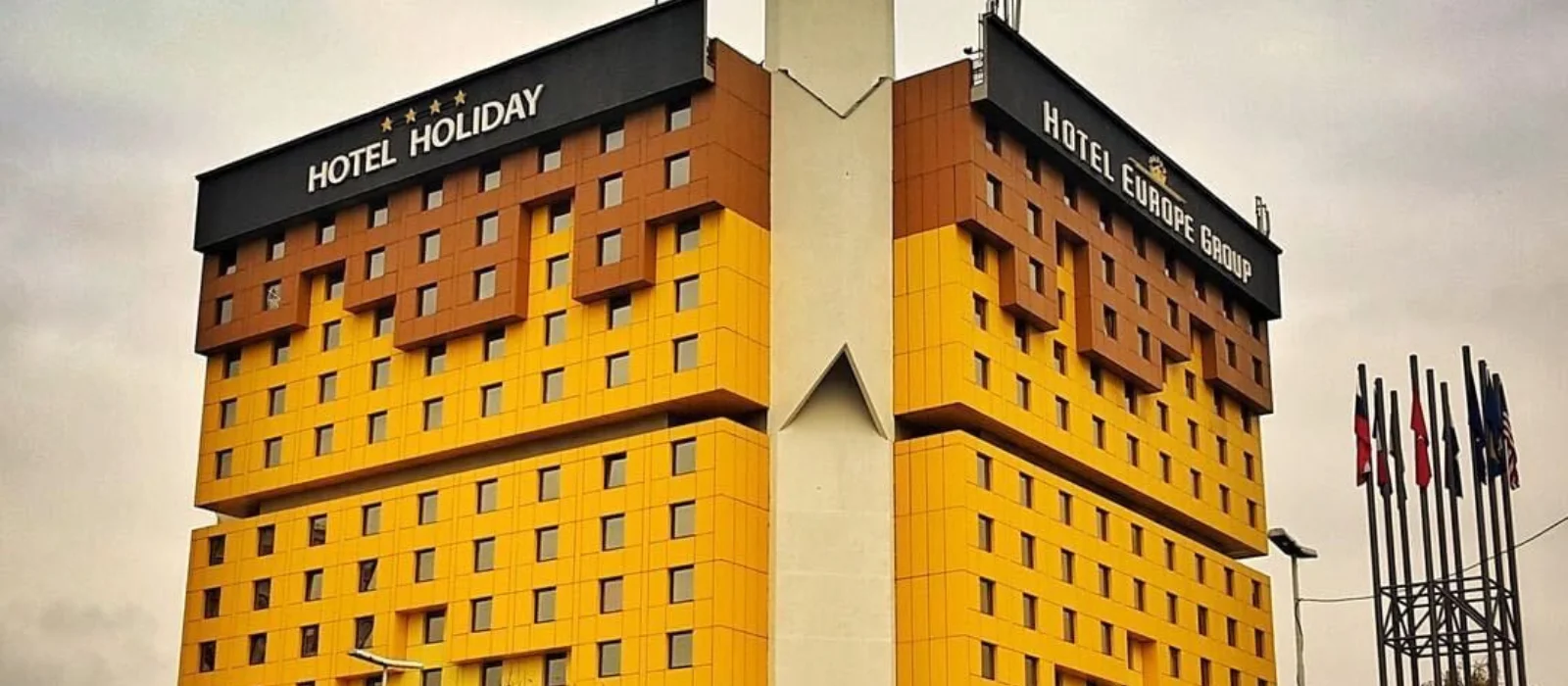
Living as I do mostly in my head, the news that I was apparently going to be in a pantomime should have been terrifying, but it made less of an impression on me than the rehearsal venue. My tram to work passed the Holiday Inn and I stared at it in fascination twice a day. Sarajevo hosted the Winter Olympics in 1984 and the hotel opened the year beforehand. Its blocky bright yellow form was mocked at first by locals, but it became associated with the buoyant confidence and optimism of that period. Only eight years after the Olympics, Bosnian Serb soldiers had installed themselves in the bobsleigh tracks in the mountains, and the hotel was occupied by the international press.
Insofar as I was driving the bus of my life during that period, I was doing my best to not flatten the people I met against the dark background of the brutal siege of the 1990s, trying to not stare at the splashes of sniper fire on buildings, the lumps knocked out by mortars, sometimes literally whistling past the graveyards. My year in the city coincided with the thirtieth anniversary of the Winter Olympics. I focused on those traces instead, especially the posters and figurines in cafes and bars of Vu?ko, the much-loved mascot of the games, a grinning wolf wearing an orange scarf drawn in the unmistakeable cartoon style of the 1980s, a cheerful reference to the wolves living in the mountains where the games took place.
I remember feeling an inconsequential and foolish figure in my old coat as I walked toward the Holiday Inn on the evening of the first rehearsal, registering the Olympic rings and logo stamped on the shrapnel-marked pillars next to the entrance. Inside, the hotel was dark and seemed not just empty but abandoned, a woozily atmospheric space of underwater half-light and muted colours. A huge sprawling potted plant was nearly dead but still trying to reclaim the entrance area. It was dwarfed by the height of the lobby, which extended the six storeys of the building. I had read about journalists abseiling down this vast space, propelled I supposed by the manic pent-up energy of the period described by my colleagues. The corridors had been built as balconies curving around this hollow lobby, which was empty apart from a crazy green-and-white striped canopy that looked for all the world like an enormous frilly beach umbrella suspended several floors above a circular bar on the ground floor. The bar was in darkness too. I took a seat on a high stool and looked around. The black-and-white zigzags of the tiles and the heavy shapes of armchairs clustered around small tables gradually became clear. My eyes were getting used to the light in this little world after the end of the world, when a boisterous blonde woman appeared, waving and calling me to follow her. We rehearsed in a room off the bar. Every Wednesday, I was surprised by its scale. Its narrow inconspicuous door looked like the entrance to a mop cupboard, but it opened into a vast space, wide with a low ceiling, a deranged mix of carpet tiles and modernist chandeliers. It became readily apparent at the first rehearsal that the play couldn’t be staged any time soon. The script wasn’t written, for one thing, and there seemed to be no plan to adapt something that already existed. We did have a story though: Snow White, for some reason. We were a motley bunch. Students from different universities were there to help backstage and the show drew on the combined creative forces, such as they were, of the British, US and German embassies, and NATO. All the main roles, thankfully, had already been promised to the people from these institutions.
The play took slow, haphazard shape. Our songs were nearly all by Electric Light Orchestra though I’d be surprised if anyone in the audience knew this. The lyrics had been adapted to include local references, largely related to food and sport, as well as some stereotypes of the city’s various neighbourhoods, and a few jokes for the parents. In the end, I was given two mercifully tiny roles: a villager and a ghost, and I was a prompt for the others because nobody ever did learn all their lines.
Christmas came and went and we still weren’t anywhere near ready. The weather had been hovering at minus ten degrees Celsius for a long time, and the paths were covered in compacted sheets of ice. We took to the stage in early March, on nights that went down to minus twenty. The panto ran for three nights, not at the Holiday Inn, but in a theatre beneath the main police station in the city, Dom Policije. I have no idea why the police station has a large underground theatre, but it is used by the Jazz Festival every year and was just around the corner from my flat, so I wasn’t complaining.
It turns out that panto audiences in Dublin and Sarajevo are much the same. They clapped and cheered. We only had one night of properly rowdy adults, when staff from the embassies came along, pissed as lords, dancing in the aisles. Probably my only real contribution to the play was the red lipstick I brought and used to paint rosy cheeks on everyone. But I did have one moment of glory: near the end of the show every night it was my job to run along the aisles throwing sweets to the excited children, who stood up to try to catch them in the air. The adults gathered the fallen sweets as ammunition and fired them towards the stage at the end of the play. The Wicked Stepmother had the final scene to herself. She was played by a Canadian with a carefully unspecified role in NATO, an incongruously genial man with an infectious laugh. The sweets rained like hailstones as he finished his routine. He loved it.
Also Read