







Does silence lead to success? How ‘The Assistant’ unveils the cold reality of office sexism
By Cathy Carey
17th May 2020
17th May 2020
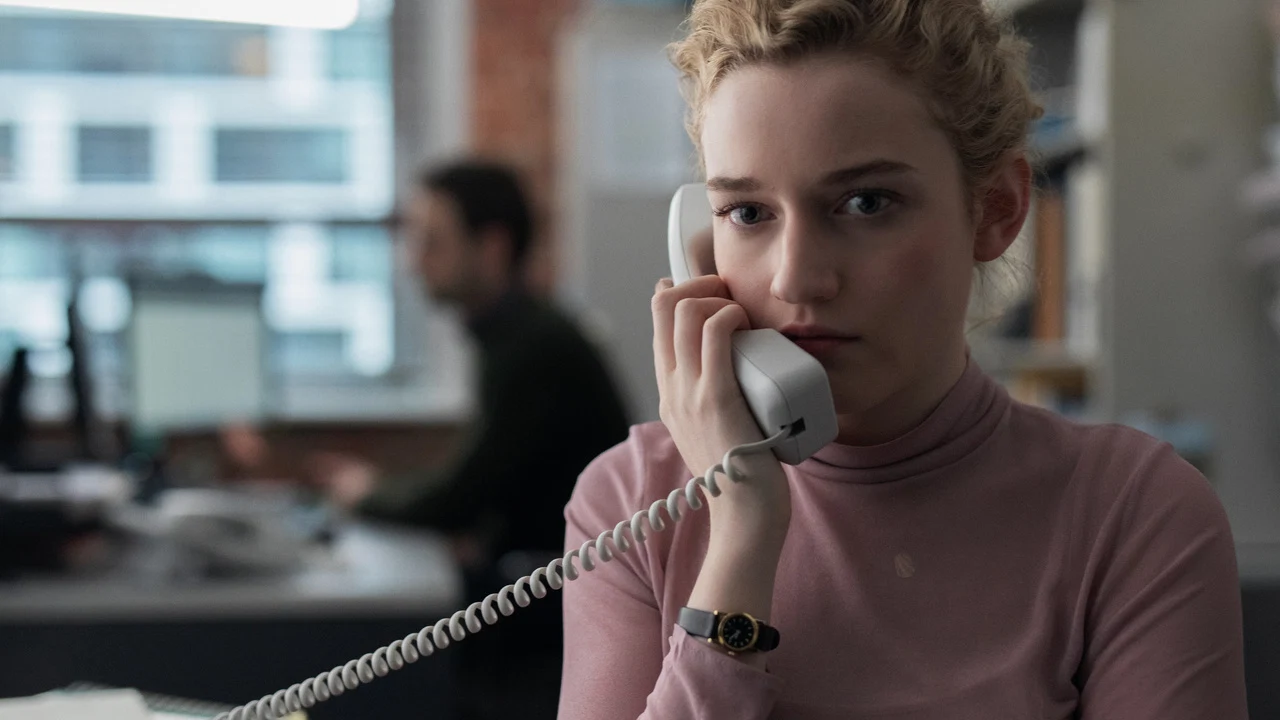
A fresh and gripping look at office and gender politics, The Assistant has just been released on streaming services.
When The Assistant was released in North America earlier this year, the jury was still out on the Weinstein case, but in writer-director Kitty Green’s eyes, the verdict was already certain. Her latest movie is a fresh take on consent, power dynamics, and the insidious nature of gaslighting in the film industry, but it’s so recognisable it could have been based in offices the world over.
The feature tracks a single working day through the eyes of the main character, a recent college graduate named Jane. Embodied by an effectively understated Julia Garner, Jane serves as our window into this stratified world, and from her lowly vantage point, we watch her grapple with long hours in a dehumanising working environment filled with the mundanity of unglamorous clerical work, bro-y colleagues, and a predatory movie mogul boss.
It’s not surprising that The Assistant initially struggled to get off the ground due to lack of financing, given the quiet but scathing nature of the critique Green levels against her own industry. Green has said it was inspired largely by interviews with women at production companies similar to the one portrayed in The Assistant, as well as her own experience with systemic sexism as a filmmaker. The conversation it’s sparked is relevant especially now, following a big victory in March for the #MeToo movement, when we have only begun the work of undoing the hidden power structures that have stealthily reduced women’s status in the workplace for a long, long time.
One of the most apt creative choices in the film is that the audience never sees Jane’s boss (who has obvious similarities to Weinstein) at all. Muttered obscenities down the phone, a disposable needle in an office trash can, exchanges concerning his travel plans, his behaviour, his wife, are all the evidence of his existence we need. Like nervous tension thrumming in the atmosphere, like the faint buzzing of florescent bulbs, the unseen male executive behind the office door is proof that harmful power dynamics are forcefully present, if not often tangible.
This imperceptible-yet-undeniable imbalance plays out especially well in a scene where Jane pays a clandestine visit to the company’s slimy HR representative, Wilcock (Matthew MacFayden). In it, she plans to report (or at least safely discuss) inappropriate behaviour she’s noticed her boss paying towards a female colleague. But if smelling the rat was the easy part, catching it is a whole lot harder.
Through a masterful campaign of feigned innocence and dextrous word-twisting, Wilcock demonstrates how her intended statement can be manipulated with devastating finesse into a very different version of events. His interpretation perverts a “co-worker protecting co-worker” narrative into one of a bookish aspiring producer who is threatened by her attractive new counterpart, disguising her envy into tattle-tale concern.
Is it an attempt to shield her colleague, or a bid to knock down the female competition? Either version is likely, depending on who you ask; the question plays into individual biases that could see her motivations through many lenses, some feminist, some less so. As the scene unfolds and we watch Jane struggle and fail to attach the right units of language to interpret what exactly the problem is, Green exposes the seed of self-doubt that destroys the confidence of women who have been gaslit so effectively their motivations have become muddled even to themselves.
Watching her challenger deftly wield his words into a spread of disorienting arguments, it’s abundantly clear this isn’t the first time he’s swatted away flies like her. At that moment, Jane sits in private parallel with the accusers in sexual abuse cases who themselves are on trial, tasked with the extraordinary burden of offering up their careers and credibility to prove they were not imagining their reality. NDA or no, if seeing is believing, then the odds are stacked decidedly against her.
The strength of the film lies in moments like this, where we’re invited to examine what course of action we would take if we were just a cog in the machine like Jane: would we offer ourselves up, and press on with the circumstantial evidence we’ve got? Or would we back down and act in self-protection?
Peeling back the veneer of respectability to expose the fabric of patriarchal control, the ultimate message lies in the banality of evil, manifested in the dreary surroundings of a corporate workplace. It bears witness to how smart, reasonable individuals adapt to their environment as they discover that they are unable to change it, and how in those surroundings, the brave (read: naive) choice rarely wins out.
That aside, the hope Green creates with this movie does not hang on the outcome of Jane’s story, but in the act of telling it. There’s something modern yet familiar in watching her bump against that broken system, and it feels as if the film has taken a small but decisive step forward in dismantling played-out stories of women with innate grudges against one another for the mere fact of their sex. By getting the audience on side, by showing, not telling, Green does what her main character can’t: she legitimises the experience of female witnesses to abuse everywhere, giving a voice to the humblest of worker bees in the office – the assistant.
The Assistant is available to buy or rent now on Google Play, iTunes and Mubi.
Read more: Harvey Weinstein found guilty of rape and sexual assault
Read more: 6 gripping post-#MeToo books made for bedtime reading
Read more: 6 excellent female-led films worth a watch this weekend
Related Stories


Also Read