








Who knew piercing your ear could have potentially serious health consequences?
By Laura George
29th Oct 2018
29th Oct 2018

Just in case you’re contemplating getting your ear cartilage pierced like everyone seems to be doing at the moment, take a deep breath and don’t rush into it on a whim like I did. Know that it will require months of aftercare, including not sleeping on it normally for weeks and twice daily 4-5 minute sessions of meticulous cleaning and drying. It’s a commitment that needs to be taken seriously because infection, which happens in roughly 34% of cases* can in rare cases, escalate quickly. One minute you’re oohing and aahing over stunning studs, the next you’re sitting in A & E schooling yourself on sepsis and toxic shock and wondering if and how they are going to extricate your jewellery from the throbbing flesh it is now embedded in.
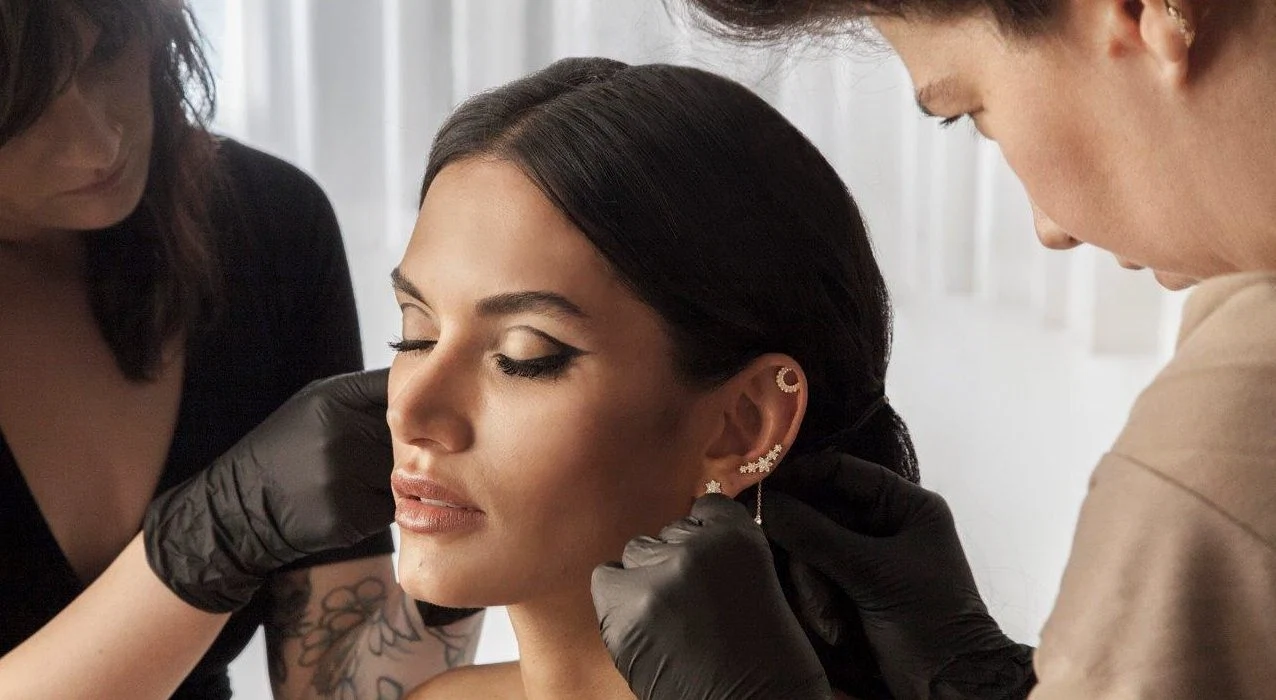
After a pretty painless double piercing in the fossa of the helix (the flattish space between the outer edge of the ear and the curvy bits which lead from the top down towards the ear opening), my ear began to feel tender to the touch one evening about two uneventful weeks after the act. I diligently washed the area with the saline solution the piercers gave me, front and back, assuming I had a minor infection. But infection to me meant the holes would get a little crusty, and it would be nothing careful extra cleaning wouldn’t fix. (As it happened, there was never any excretion whatsoever, which I misinterpreted as a good sign.)
A&E visit
But an infection of the cartilage isn’t anything like the same as an infection of the lobe. “Cartilage in the outer ear and the nose is susceptible to infection because the tissue does not have an adequate blood supply to bring immune cells from the body to help fight off infections,” explains Dr. Joseph Adrian Tyndall, program director of emergency medicine residency at the Brooklyn Hospital Center in New York.
This means infection not only festers, but gallops. My timeline was like this: by morning the upper ear was a little red/purple, by lunch it had begun to swell and by mid-afternoon it was so engorged it looked like a balloon and I could feel the infection’s tendrils going up into my scalp. Long story short, I left work to go to the chemist, the chemist sent me straight to the GP and the GP sent me straight to A & E. I just about dodged IV antibiotics and having the earrings cut out (the majority of my Google research in the waiting room said that it’s better to leave them in so pus has an easy exit route). I escaped with a two-week course of penicillin, a fistful of painkillers and anti-inflammatories and recommended bed rest. It seems absurd to miss two days of work for a piercing but I was properly ropey all over; not just my ear hurt.
Be obsessive about aftercare
There’s been some additional relief to be had from alternating super hot and cold compresses (but be careful to dry the area well after- a hairdryer does it best) and plenty of rest (on one side only) while the drugs do their jobs. The hot compresses draw blood to the area, the cold ones make it feel better. For a minor infection, this might even be enough to get you through.
So, knowing what I know now, would I do it again? In all honesty, I’m not sure because I’m not out of the woods yet: healing takes between 3-6 months. If this is the last of the problems, I probably would because my new little glittering stars are very pretty against a normal earscape. But, if I had a do over, I’d be much more obsessive about aftercare because infection can come from anywhere at any time and I’d be MUCH quicker to react to the initial signs of trouble- tenderness, discolouration and swelling. If you experience any of these, remove any other piercings you may have in the same ear even if they are in an as yet unaffected area and have been there for years and see your GP. Don’t wait around.
*(Dr Shari Welch , ABC News https://abcnews.go.com/Health/


Also Read