






Hearing impairment and autism: Why we should be talking about transparent face masks
By Shayna Healy
26th May 2020
26th May 2020
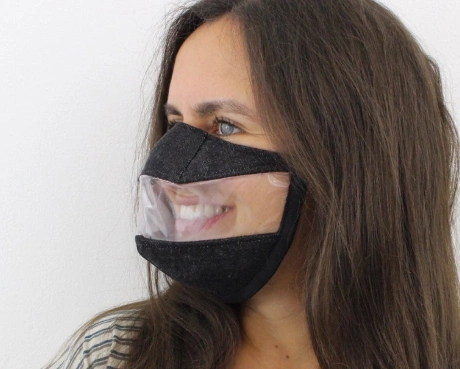
Transparent face masks can make a huge difference to those with hearing impairment and additional educational needs. Here’s how to make one at home.
While face masks can help stop the spread of infection, they also cover the mouth fully, making it difficult for those reliant on visual communication.
According to the Irish Society of Hearing Aid Audiologists, a quarter of a million adults and an estimated 4,500 preschool and school age children in Ireland will have a permanent hearing impairment.
Many of these rely on lip-reading as a form of communication, without which they can experience potential consequences for education, communication, literacy and social and emotional development.
Inhibited communication
A recent survey asked 302 people with hearing loss about how the frequent use of face masks will affect their everyday lives.
79 percent said face masks make life much harder, with 69 percent saying their growing use is making them worried they will more regularly mishear or misunderstand. Nearly half said they are worried it will make them more isolated, and a third said they are fearful it will reduce their independence.
However, clear masks do not just aid the hearing impaired but can also significantly help children with autism and additional educational needs.

Autism and face masks
A mother of a 19-year-old diagnosed with autism wrote in The Washington Post about the difficulties her son has had with face masks.
Breathing and sensory difficulties due to the cloth touching his face has caused him not to be able to wear a regular face mask.
Other problems include fogged up glasses, intensified smell of one’s breath, and the dangers of epileptic episodes.
“A significant percentage of autistic children have seizure disorders,” she said. “Not being able to see an epileptic child’s face can be a safety risk if they have distinctive pre-seizure facial expressions.”
This is why masks with clear sections over the mouth can be a helpful solution.
Transparent mask tutorials
However, clear masks are not easy to come by when shopping online. While some are available on Etsy, the few big companies that are selling them have reserved their stock for hospital staff and/or bulk orders only
That is why people like Wendy Schellemans, an education assistant at a special needs school with several deaf pupils, decided to make her own transparent mask at home.
Other similar tutorials have emerged as well, proving that making reusable clear masks at home is easier than it looks.
All you need is: soap, plastic (from a folder), scissors, fabric, needle and thread (or a hot glue gun) and ribbon.
The Hearing, Speech & Deaf Centre has a step-by-step tutorial available or you can follow the how-to video below:
It is great to see people raising awareness about this need during the current pandemic.
Hopefully, more options will come in time for those with hearing impairment and additional educational needs.
Feature image: Etsy
Read more: We love these Irish face masks made from recycled ocean plastic, and so does Leonardo DiCaprio
Read more: Notes from lockdown: ‘I hold back tears so as not to worry my sensitive four-year-old’
Read more: ‘The world has adjusted to our normal’ – how it feels to have a child with special needs during Covid-19
Also Read